

A water storage tank rarely fits into a standard specification once the project moves beyond a straightforward commercial installation. Industrial plants, municipal water systems, fire protection projects, irrigation networks and water treatment facilities often have different capacity requirements, site limitations, water characteristics, structural loads and connection arrangements.
This is where the engineering capability of a Zincalume Tank manufacturer in India becomes important. A manufacturer is not simply supplying a set of steel panels. The tank needs to be designed around the available footprint, required storage volume, operating conditions, foundation, access requirements, inlet and outlet connections, liner selection and installation method.
For project owners, consultants and EPC contractors, custom tank design therefore starts well before manufacturing. It begins with understanding the application and converting project requirements into a practical storage system.
Custom Tank Design Starts with Project Requirements
The first stage is requirement assessment. A manufacturer needs more information than the required capacity alone.
A technically sound design typically considers:
- Required storage capacity
- Type of liquid to be stored
- Available site area
- Tank height and diameter limitations
- Foundation arrangement
- Operating temperature
- Water chemistry and pH
- Wind conditions
- Seismic considerations
- Required inlet and outlet connections
- Overflow and drain arrangements
- Access and inspection requirements
- Ladder, platform and roof requirements
- Future expansion requirements
- Transportation and site access
- Installation conditions
For example, a 5,00,000-litre process-water tank for an industrial facility may require a very different configuration from a municipal potable-water tank of the same nominal capacity. The stored liquid, operating environment, connection requirements and project standards can all influence the final engineering.
This is why experienced Zincalume Steel Water Tank Manufacturers begin with a project brief rather than simply selecting a tank from a catalogue.
Capacity Is Only One Part of Tank Engineering
Storage volume is one of the first parameters defined, but it does not determine the complete tank configuration.
Greenline Steels’ stated storage range extends from 5,000 litres to 25,00,000 litres, allowing the tank configuration to be developed according to the requirements of the project.
A manufacturer may adjust the tank’s diameter, height and panel arrangement to achieve the required volume while working within the available site footprint.
For a constrained site, increasing the height may be more practical than increasing the diameter. In another project, a lower-profile tank may be preferable because of access restrictions, structural considerations or surrounding infrastructure.
This makes dimensional engineering an important part of custom tank design.
Typical project parameters
| Design Parameter | Why It Matters |
| Storage capacity | Establishes the required liquid volume |
| Tank diameter | Determines footprint and structural configuration |
| Tank height | Influences pressure, access and site suitability |
| Steel thickness | Selected according to engineering requirements |
| Liner thickness | Determines the containment system specification |
| Foundation | Transfers tank loads safely to the supporting structure |
| Wind load | Influences structural design and anchoring |
| Seismic conditions | Important for projects in higher seismic zones |
| Nozzle arrangement | Allows integration with piping systems |
| Roof configuration | Depends on application and site requirements |
| Access system | Supports inspection, maintenance and operation |
The design is therefore a combination of hydraulic, structural, material and site considerations rather than a simple capacity calculation.
Selecting the Right Zincalume Steel Specification
Material selection directly affects the tank’s structural performance and service life.
Greenline Steels specifies Zincalume steel with an aluminium-zinc alloy coating comprising 55% aluminium, 43.5% zinc and 1.5% silicon. The supplied tank specifications indicate steel thicknesses ranging from 0.55 mm to 1.00 mm, depending on project requirements.
The coating provides corrosion protection while the steel substrate provides the structural strength required for the tank shell.
Zincalume steel itself is an aluminium-zinc coated steel product developed for corrosion resistance across different climatic conditions. Tata Steel Colors states that ZINCALUME steel is available with 150 g/m² or 200 g/m² metallic coating and complies with standards including AS1397, ASTM A792M, IS 15961 and ISO 9364.
For a custom tank, the important point is that the material specification should correspond with the design conditions. A manufacturer should not treat steel thickness, coating and structural configuration as interchangeable parameters.
Liner Engineering Depends on the Stored Liquid
The steel shell provides structural containment, while the liner forms the internal water-contact barrier in Greenline Steels’ tank configuration.
The company’s standard specifications identify a reinforced PVC membrane liner with thickness options from 0.55 mm to 0.70 mm.
Liner selection should take into account the nature of the stored liquid, expected operating conditions and project requirements. Potable water, raw water, industrial process water and treated wastewater can impose different requirements on the internal containment system.
This is particularly important in industrial projects where the liquid may have characteristics that differ significantly from ordinary water.
A capable Zincalume tank manufacturer therefore needs to consider the liner as part of the tank engineering rather than treating it as an accessory added after the steel structure has been designed.
Designing Around Wind and Seismic Conditions
Indian projects can present widely different structural conditions. A tank installed in a coastal region, an exposed industrial site or a seismic area cannot automatically be designed using the same assumptions as a tank installed in a sheltered location.
Wind loading can affect the shell, roof, anchoring and foundation connection. Seismic loading can influence the tank’s structural stability, support arrangement and connection details.
The design therefore needs to account for the project’s location and applicable engineering requirements.
The distinction is important for buyers comparing Best Zincalume tank manufacturers in India. A manufacturer’s technical capability should be assessed by how it approaches project-specific structural requirements, not simply by the thickness of the steel or the quoted tank capacity.
Foundation and Site Conditions Influence the Final Design
A modular steel tank still requires an appropriately engineered foundation.
Before fabrication, the project team needs to establish the foundation arrangement, site level, bearing conditions, access requirements and tank loading. The foundation transfers the tank and stored-water loads into the ground or supporting structure.
The manufacturer may provide foundation loading information and installation requirements so that the civil engineering team can prepare the site correctly.
This coordination becomes particularly important for large tanks. A tank holding 10,00,000 litres contains approximately 1,000 tonnes of water, before the weight of the tank structure, roof, fittings and other components is considered.
That single figure demonstrates why tank capacity cannot be treated as a simple product attribute. Large storage systems involve significant structural loads that must be addressed during project planning.
Customising Nozzles, Connections and Accessories
Tank engineering also involves integration with the wider water system.
A custom tank may require specific arrangements for:
- Inlet connections
- Outlet connections
- Overflow
- Drainage
- Ventilation
- Level measurement
- Manholes
- Ladders
- Access platforms
- Inspection points
- Piping interfaces
The position and size of these components should correspond with the project’s piping layout and operational requirements.
For example, an industrial process-water installation may have several pipe connections at different elevations, while a fire-water tank may require connections positioned according to the fire protection system design.
This is one reason project drawings and piping information should be shared with the manufacturer before fabrication begins.
Modular Construction Makes Customisation Practical
One of the principal engineering advantages of a bolted Zincalume fire water tank is modular construction.
Instead of transporting a complete welded tank to the project site, the tank is supplied in panels and components that can be transported and assembled at the installation location.
This has practical implications for custom engineering. A Zincalume Fire Water Tank manufacturer can use panel-based construction to make it easier to adapt tank dimensions to the project site, transport components to locations with restricted access and assemble the system without extensive on-site fabrication.
It can also support future expansion. If a facility’s water demand increases, the modular design can allow the storage system to be reconsidered for additional capacity rather than automatically requiring complete replacement.
For remote or difficult-to-access projects, the transportation advantage can be particularly relevant because individual components are easier to handle than a fully fabricated large-capacity vessel.
How Manufacturers Move from Design to Fabrication
A professional custom tank project generally follows a structured engineering sequence.
1. Requirement analysis
The manufacturer reviews capacity, application, site conditions, water characteristics and project requirements.
2. Preliminary configuration
Tank dimensions, structural arrangement, liner requirements and major accessories are established.
3. Engineering calculations
The design team evaluates the relevant structural and operational loads and determines the required specifications.
4. Detailed drawings
Fabrication and installation drawings are prepared, including panel configuration, connections, nozzles and accessories.
5. Material selection
Steel sheets, liners, fasteners, fittings and other components are specified according to the approved design.
6. Manufacturing
Panels and associated components are fabricated according to the engineering drawings and specified tolerances.
7. Quality inspection
Materials and manufactured components undergo inspection before dispatch.
8. Site installation
The modular components are assembled at the prepared foundation.
9. Testing and commissioning
The completed system is inspected and checked before being placed into service.
This process reduces the risk of discovering design conflicts after manufacturing has already started.
Why Project-Specific Engineering Matters for Industrial Applications
Industrial storage requirements can change considerably from project to project.
A manufacturing plant may require process-water storage. A pharmaceutical facility may have specific water-handling requirements. A municipal project may need large-volume potable-water storage. An agricultural installation may prioritise irrigation capacity and accessibility.
The same tank material can therefore be used across different applications while the engineering configuration changes.
The manufacturer’s role is to translate these application requirements into a storage system that can be manufactured, transported, installed and operated within the project’s constraints.
This is the distinction between purchasing a standard tank and engaging a technically capable Zincalume tank manufacturer in India.
What Buyers Should Request from a Manufacturer
Before placing an order, project teams should ask for sufficient technical information to evaluate the proposed tank.
A useful technical submission should address:
- Tank capacity and dimensions
- Steel material and coating specification
- Steel thickness
- Liner material and thickness
- Design conditions
- Wind and seismic assumptions where applicable
- Foundation requirements
- Nozzle schedule
- Roof configuration
- Access arrangements
- Accessories
- Installation methodology
- Inspection and testing procedures
- Warranty terms
- After-sales support
Buyers should also check whether the manufacturer can provide engineering assistance rather than simply supplying fabricated components.
For large infrastructure projects, this distinction can have a direct effect on project coordination and installation.
How Greenline Steels Pvt Ltd Approaches Custom Tank Engineering
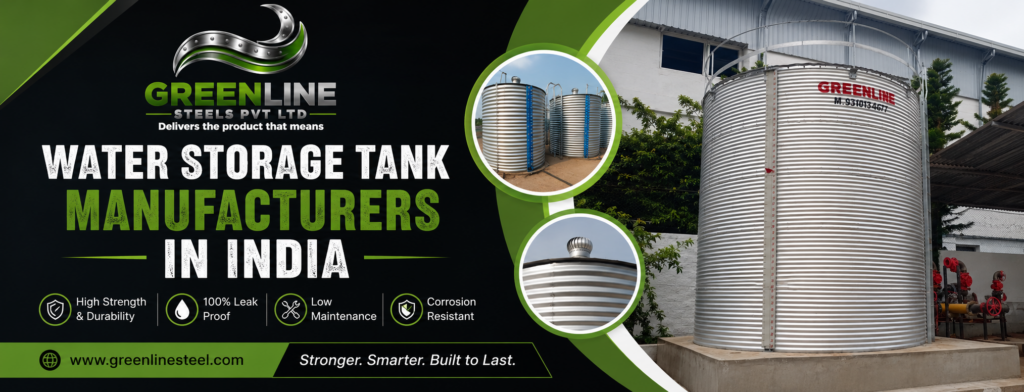
At Greenline Steels Pvt Ltd, we approach each Zincalume tank project around its actual application, site conditions and storage requirements rather than treating every installation as a standard product. As experienced Water storage tank manufacturers in India, we use Zincalume steel panels and reinforced waterproof liners, with capacities ranging from 5,000 litres to 25,00,000 litres according to project specifications. We work with consultants, contractors, industries, government organisations and infrastructure developers to develop storage configurations suited to their requirements. Our modular bolted construction supports efficient transportation and on-site assembly, while our project support extends from requirement analysis and engineering through manufacturing, installation guidance and after-sales service. With our focus on customised dimensions, material quality and practical installation, we aim to provide storage systems that remain technically suitable throughout their intended service life.
A Practical Evaluation Framework for Indian Tank Buyers
When evaluating a Zincalume Tank manufacturer in India, price should not be the only comparison point.
A lower initial quotation may not represent lower project cost if the proposal excludes important accessories, engineering support, foundation information, installation assistance or required testing.
A more useful evaluation compares the complete technical scope.
| Evaluation Area | Questions to Ask |
| Engineering | Does the manufacturer provide project-specific design? |
| Materials | What steel grade, coating and thickness are specified? |
| Liner | Is the liner suitable for the stored liquid? |
| Capacity | Can dimensions be customised to the available site? |
| Structural design | Are location-specific loads considered? |
| Accessories | Are nozzles, ladders, vents and access systems included? |
| Installation | Who handles or supports site assembly? |
| Quality | What inspections are performed before dispatch? |
| Expansion | Can capacity be increased later? |
| Support | Is technical assistance available after installation? |
This approach allows EPC contractors and project owners to compare manufacturers on engineering competence rather than marketing claims.
Customisation Should Serve the Project, Not Complicate It
Custom design does not mean adding unnecessary complexity. The objective is to produce a storage system that fits the site’s physical constraints and performs according to the project’s operational requirements.
For a manufacturer, this requires coordination between design, material selection, fabrication and installation. For the buyer, it means providing accurate project information early enough for the engineering team to incorporate it into the tank design.
The result is a more predictable project from procurement through commissioning.
Conclusion
Custom Zincalume tank engineering in India involves considerably more than selecting a storage capacity. Tank dimensions, steel specifications, liner requirements, foundation conditions, environmental loads, connections, accessories, transportation and installation all influence the final design.
The right Zincalume tank manufacturer should therefore function as an engineering and project partner, particularly when the tank forms part of a larger industrial, municipal, agricultural or infrastructure system.
For buyers, the most important question is not simply how much water the tank can hold. It is whether the proposed design has been developed around the actual requirements of the project and whether the manufacturer has the technical capability to take that design from specification to installation.