


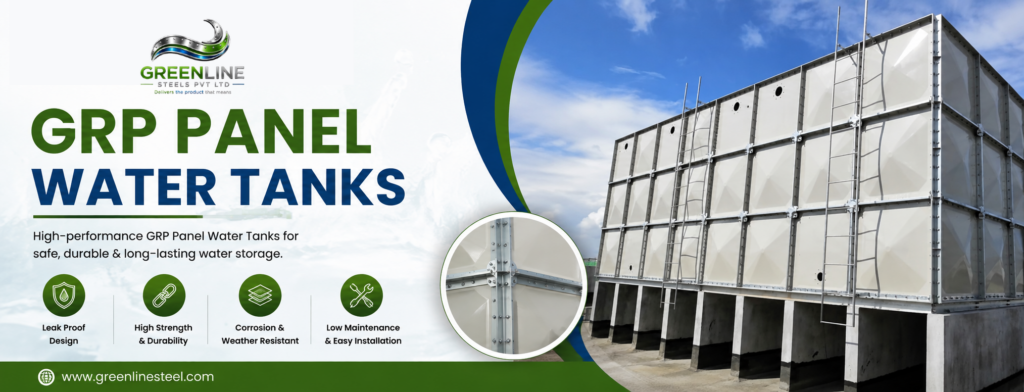
GRP panel water tanks are engineered systems in which panel thickness, reinforcement, SMC and GRP water tank manufacturers in Indiapanel geometry and tank configuration work together to resist hydrostatic pressure and maintain structural stability. Selecting panels simply by tank capacity is therefore not sufficient. A 100 KL tank, for example, can have very different structural requirements depending on its height, footprint, panel arrangement, support system, installation environment and intended application.
For project engineers, consultants, EPC contractors and procurement teams, these parameters directly influence deflection, joint loading, leakage risk, service life, installation requirements and overall project cost.
The Indian Standard framework is particularly relevant here. IS 14399 Part 1 covers GRP sectional tank panels, while Part 2 addresses assembly, installation and testing. BIS documentation identifies three panel categories under the standard, with minimum thicknesses of 3 mm for Type A, 4 mm for Type B and 5 mm for Type C panels. The standard also relates panel selection to tank depth, with thicker panel categories assigned to lower sections where hydrostatic loading is higher.
Why Panel Thickness Cannot Be Selected in Isolation
Hydrostatic pressure increases with water depth. The basic relationship is:
P = ρgh
where:
- P = hydrostatic pressure
- ρ = water density
- g = gravitational acceleration
- h = water depth
For water, pressure increases by approximately 9.81 kPa for every metre of depth.
| Water depth | Approx. pressure at tank bottom |
| 1 m | 9.81 kPa |
| 2 m | 19.62 kPa |
| 3 m | 29.43 kPa |
| 4 m | 39.24 kPa |
| 5 m | 49.05 kPa |
These figures explain why tank height is such an important structural parameter. The bottom section of a 4 m high tank experiences substantially greater hydrostatic pressure than the upper section.
Panel thickness provides greater resistance to bending and deformation, but simply specifying a thicker panel throughout the tank is not necessarily the most technically or economically appropriate solution. Sectional tank design commonly uses different panel categories at different elevations. BIS grouping guidance, for example, assigns Type A panels to the upper portions and progressively stronger panel types to lower portions as tank depth increases.
The practical objective is therefore load-appropriate thickness, not maximum thickness everywhere.
How Panel Thickness Influences Structural Performance
An GRP panel behaves as a structural composite rather than as a simple sheet of uniform plastic. Its performance depends on resin formulation, glass fibre reinforcement, panel geometry, moulding quality, thickness and support conditions.
Increasing panel thickness can improve resistance to:
- Bending under hydrostatic pressure
- Local deformation
- Panel deflection
- Mechanical damage during handling
- Long-term dimensional instability
However, thickness also increases panel weight. Heavier panels can affect transportation, handling, lifting requirements and installation productivity.
This is why professional GRP Panel Tanks Manufacturers in India should not recommend panel thickness solely on the basis of nominal capacity. Tank height, panel span, support arrangement, operating conditions and the location of each panel within the tank need to be considered together.
The BIS documentation provides a useful illustration of this approach. For tanks up to 1 m depth, Type A panels are identified for the top, bottom and side positions. At 2 m depth, Type B panels are used for the bottom and lower side tier, while Type A panels remain applicable to the upper tier. For tanks up to 3 m, Type C panels are used at the bottom and lowest side tier, Type B in the middle tier and Type A at the top.
This tiered arrangement reflects the changing hydrostatic load through the tank height.
Reinforcement Determines How Panels Carry the Load
Panel thickness is only part of the structural equation. Reinforcement controls how the tank manages panel deflection and transfers loads between individual sections.
Reinforcement may include:
- Internal tie rods
- External structural channels
- Vertical stiffeners
- Horizontal bracing
- Base support frames
- Roof support members
- Special reinforcement around openings and nozzles
The choice depends on tank dimensions, panel configuration, water depth and the selected structural system.
For taller tanks, reinforcement becomes increasingly important because the hydrostatic load is transferred through the side panels into joints, supports and the base structure. If the panel system is insufficiently supported, simply increasing the nominal panel thickness may not resolve the underlying structural issue.
A project specification should therefore define both panel properties and reinforcement arrangement.
Panel Thickness and Reinforcement: A Practical Comparison
| Design approach | Structural implication | Project implication |
| Thin panel with inadequate support | Higher deflection risk | Poor long-term performance |
| Thick panel without appropriate bracing | May still experience system-level deformation | Higher material and handling cost |
| Correct thickness with engineered reinforcement | Balanced load distribution | Better structural efficiency |
| Uniform thickness throughout | Simple specification but may be inefficient | Potentially higher project cost |
| Tiered thickness based on water depth | Matches panel strength to loading | Better material utilisation |
The exact reinforcement arrangement should always follow the approved structural design and applicable project specification rather than a generic thickness chart.
Tank Height Has a Greater Structural Effect Than Capacity Alone
A common procurement mistake is to compare tanks primarily by volume.
Consider two tanks with approximately the same capacity:
- Tank A: 10 m × 10 m × 1 m
- Tank B: 5 m × 5 m × 4 m
Both hold approximately 100 KL, but they do not have the same structural requirements.
Tank B has four times the water depth. Its bottom hydrostatic pressure is approximately 39.24 kPa, compared with 9.81 kPa for Tank A.
This illustrates why capacity alone cannot determine panel thickness.
For an engineering evaluation, the following parameters should be assessed together:
| Parameter | Why it matters |
| Storage capacity | Establishes required water volume |
| Tank height | Determines hydrostatic pressure |
| Length and width | Affect panel span and configuration |
| Panel size | Influences load distribution and joint count |
| Panel thickness | Influences stiffness and load resistance |
| Reinforcement | Controls structural support and deflection |
| Base design | Transfers tank loads to the foundation |
| Joint system | Influences water tightness |
| Nozzle arrangement | Creates local structural considerations |
| Installation environment | Determines access and construction constraints |
Panel Geometry Also Affects Performance
Modern GRP panel water tanks are assembled from modular panels rather than fabricated as a single continuous vessel. This provides significant logistical advantages, particularly where tanks must be installed in restricted-access locations.
However, modularity introduces joints. Each panel-to-panel connection becomes part of the overall structural and water-retention system.
Panel geometry can influence:
- Load distribution
- Stiffness
- Joint frequency
- Internal support requirements
- Assembly time
- Transportation efficiency
- Access for maintenance
- Location of inlet, outlet and drain connections
The panel contour is also important. IS 14399 describes side panels as being contoured to withstand hydrostatic loading corresponding to tank water depth, while bottom panels are contoured to withstand the depth-related load and help avoid water stagnation.
Therefore, a technically sound specification should identify panel type, dimensions, thickness, configuration and support arrangement rather than treating all panels as interchangeable.
Why Bottom Panels Usually Require Greater Structural Attention
The bottom of a sectional tank performs two critical functions.
First, it receives the load transmitted from the water column and side panels. Second, it transfers the accumulated load to the supporting foundation or base frame.
For this reason, bottom panels frequently require higher structural capacity than roof panels.
The distinction becomes more significant as tank height increases. A 3 m water column produces approximately 29.43 kPa hydrostatic pressure at the bottom, before considering other design factors.
The foundation must also be level and adequately designed. Even a correctly manufactured panel can perform poorly if the supporting surface produces uneven loading.
For large tanks, the engineering review should therefore cover the complete load path:
Water → panel → reinforcement/joints → base structure → foundation
A weakness anywhere along this path can affect the overall tank performance.
Configuration Influences Joint Loading and Leakage Risk
The performance of a Grp GRP Panel Water Storage Tank depends not only on the strength of individual panels but also on how they are assembled.
Joint design should address:
- Correct gasket selection
- Bolt spacing and tightening
- Panel alignment
- Surface condition
- Joint compression
- Internal and external reinforcement
- Proper installation sequence
A panel can meet its material specification and still contribute to leakage if the joint system is poorly installed.
For potable water applications, the sealing materials and components in contact with stored water should also be appropriate for the intended application. This is particularly important for hospitals, residential developments, institutional buildings and municipal water systems.
Designing Around Site Constraints
One of the major advantages of sectional tanks is that panels can be transported to sites where a monolithic tank would be difficult to deliver.
This makes configuration particularly important for:
- Rooftop installations
- Basement installations
- Existing industrial facilities
- Hospitals
- Commercial buildings
- Water treatment plants
- Fire protection systems
- Sites with restricted vehicle access
A modular tank can be planned around available access routes, lifting arrangements and installation space. Panel dimensions should be selected with transportation and assembly constraints in mind.
For large projects, the tank layout should be reviewed before manufacturing begins. This helps identify access restrictions, foundation dimensions, nozzle positions, manholes, maintenance clearances and reinforcement requirements.
Quality Control Should Verify More Than Panel Thickness
A procurement inspection should not stop at measuring panel thickness.
A comprehensive quality review should consider:
- Panel dimensions
- Thickness consistency
- Surface defects
- Fibre exposure
- Cracks and crazing
- Resin impregnation
- Panel contour
- Mechanical properties
- Fastener quality
- Gasket material
- Reinforcement components
- Assembly accuracy
- Leakage testing
IS 14399 Part 1 addresses panel requirements, while Part 2 covers assembly, installation and testing of GRP sectional tanks.
This distinction is important because manufacturing quality and installation quality are separate parts of final tank performance.
Key Engineering Parameters at a Glance
The following framework can be used when reviewing an GRP tank proposal:
| Design factor | Primary performance effect | What the buyer should verify |
| Panel thickness | Bending resistance and stiffness | Thickness schedule by tank elevation |
| Glass reinforcement | Composite strength | Material and manufacturing specification |
| Panel contour | Load resistance | Approved panel design |
| Tank height | Hydrostatic pressure | Maximum operating water depth |
| Internal reinforcement | Controls deformation | Rod, tie and bracing arrangement |
| External reinforcement | Structural stability | Channel/frame specification |
| Base support | Load transfer | Foundation and support details |
| Joint system | Water tightness | Gasket and fastening specification |
| Panel configuration | Load distribution and installation | Layout drawings |
| Testing | Confirms finished performance | Inspection and leakage test records |
How Buyers Can Evaluate Manufacturers More Effectively
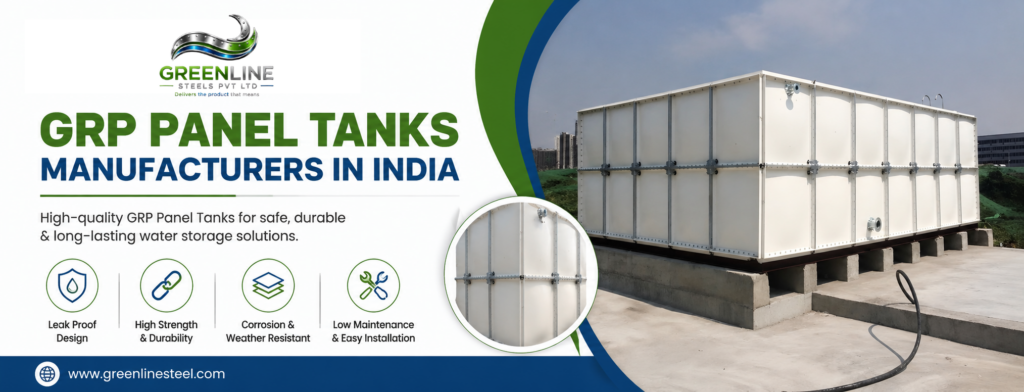
When comparing GRP and GRP water tank manufacturers in India, buyers should request a technical submission rather than comparing only price per KL.
The submission should ideally identify:
- Tank dimensions
- Effective and nominal capacity
- Water depth
- Panel thickness schedule
- Panel classification
- Reinforcement details
- Foundation requirements
- Jointing system
- Material specifications
- Applicable standards
- Testing procedure
- Installation methodology
- Warranty terms
- Delivery scope
This approach makes it easier to distinguish a properly engineered proposal from a quotation based primarily on capacity and material quantity.
For procurement teams researching the Best GRP Panel Tank Suppliers in India, the important question is not simply who supplies the largest tank. The more relevant question is whether the supplier can demonstrate a technically appropriate relationship between tank depth, panel thickness, reinforcement, configuration, installation and testing.
Why Greenline Steels Pvt Ltd Is Suited to Project-Specific GRP Tank Requirements
At Greenline Steels Pvt Ltd, we approach GRP water storage as a project-specific requirement rather than applying the same configuration to every installation. We provide customised tank capacities from 1 KL to 1000 KL+ and support applications including potable water, fire water, process water, rainwater harvesting, HVAC and industrial storage. Our modular panel systems are designed for practical transportation, installation and future capacity considerations. We also provide engineering support, customised manufacturing, quality inspection and delivery across India. Our focus is to ensure that the selected tank configuration matches the project’s capacity, site conditions and intended application while maintaining the required structural and operational performance.
Conclusion
GRP water tank performance is determined by the interaction of several engineering variables. Panel thickness provides resistance to hydrostatic loading, but thickness alone does not establish structural adequacy. Reinforcement controls deformation and load transfer, while tank height determines the magnitude of hydrostatic pressure. Panel geometry, joint configuration, foundation design and installation quality complete the structural system.
For project engineers and procurement teams, the correct approach is therefore to evaluate the complete tank configuration, not just capacity or panel thickness.
A properly specified tank should demonstrate a clear relationship between water depth, panel classification, thickness, reinforcement, support structure, jointing system and testing requirements. This becomes particularly important for large commercial, industrial, municipal, fire protection and institutional projects where tank performance must remain reliable throughout its operating life.
Choosing experienced GRP Panel Tanks Manufacturers in India with the capability to provide project-specific engineering and technical documentation can help reduce specification errors, installation problems and avoidable lifecycle costs.