


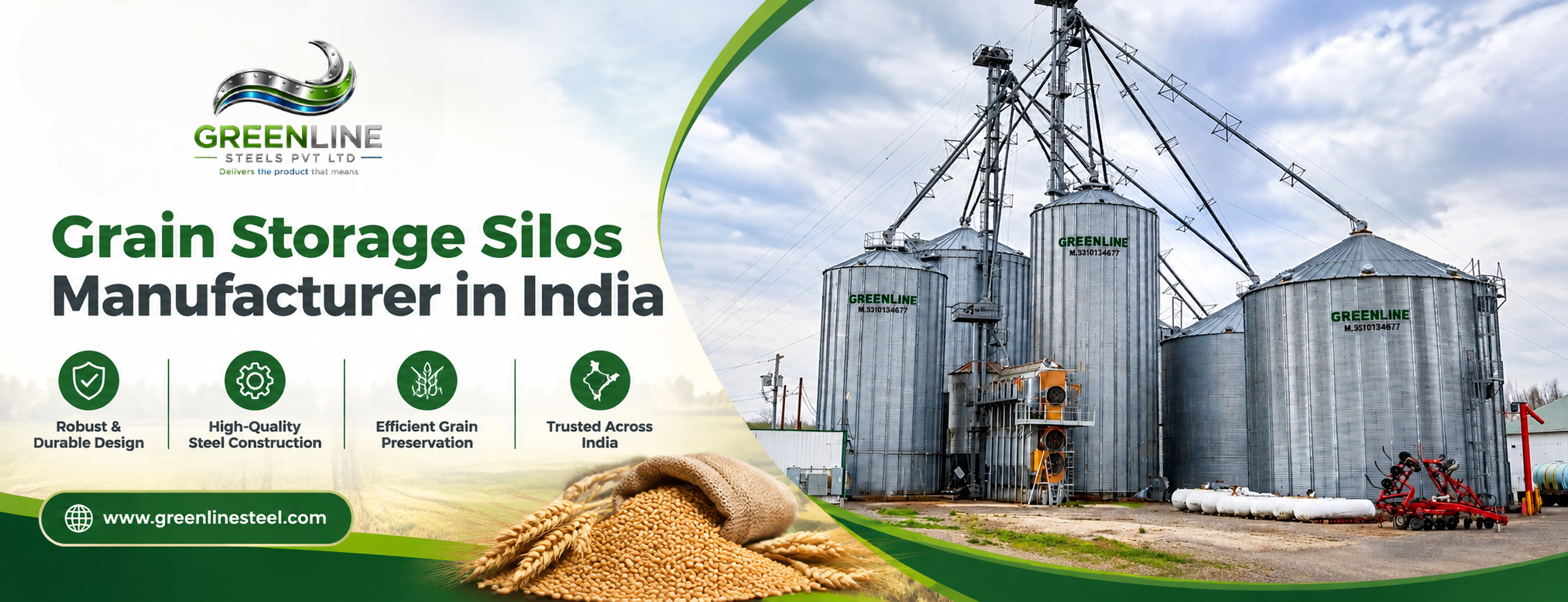
India’s agricultural sector is producing and handling grain at a scale that places increasing pressure on storage infrastructure. The final estimates for 2024-25 put India’s total foodgrain production at 357.73 million tonnes, compared with 332.30 million tonnes in 2023-24. Rice production reached 150.18 million tonnes, while wheat production stood at 117.95 million tonnes.
For agro-industries, this scale of production creates a practical engineering requirement: grain must be stored in structures that protect quality while supporting efficient loading, controlled storage and reliable discharge. A grain silo is therefore not simply a large container. Its structural configuration, material selection, capacity, foundation, loading system, discharge arrangement, environmental protection and maintenance requirements all affect its performance.
For organisations planning a new storage facility or expanding an existing one, selecting a suitable Grain Storage Silos Manufacturer in India requires more than comparing quoted prices. The engineering specification needs to match the grain, operating conditions, available land, handling system and expected storage cycle.
Why Engineering Matters in Grain Silo Procurement
Bulk grain behaves differently from many conventional stored materials. The stored mass creates vertical and lateral pressures on the silo walls, while filling and discharge can introduce additional dynamic and eccentric loading conditions.
Indian Standard IS 9178 addresses criteria for the design of steel bins used for bulk materials, including general requirements and assessment of loads. The standard is therefore relevant when evaluating the engineering basis of steel bulk-storage structures.
A procurement decision should consequently consider the complete storage system rather than the silo shell alone.
| Engineering consideration | Why it matters |
| Storage capacity | Determines how much grain can be held per storage cycle |
| Grain characteristics | Influences pressure, flow and discharge behaviour |
| Steel specification | Affects structural strength and service life |
| Silo geometry | Influences storage efficiency and material flow |
| Foundation design | Transfers structural and stored-material loads safely |
| Moisture protection | Helps protect grain quality during storage |
| Loading system | Determines filling efficiency and operational throughput |
| Discharge system | Supports controlled and efficient unloading |
| Site conditions | Affect foundation, access, installation and drainage |
| Maintenance access | Determines inspection and servicing efficiency |
1. Determine the Required Storage Capacity
Capacity should be established from the operation’s actual material flow rather than selecting a silo based solely on available models.
An agro-processing facility should examine annual procurement, peak-season intake, average daily consumption, dispatch volumes and the desired buffer stock. A rice mill, for example, may require a different storage strategy from a grain trading facility or a flour mill.
Capacity planning should also consider whether multiple silos are more practical than a single large unit. Several silos can allow different grains, grades or batches to be stored separately while providing greater flexibility during maintenance and dispatch.
The capacity calculation should account for:
- Annual grain intake
- Peak procurement periods
- Average processing rate
- Desired reserve stock
- Grain density
- Number of storage cycles
- Loading and unloading rates
- Future expansion requirements
India’s record foodgrain output reinforces the importance of scalable storage infrastructure. The country’s 2024-25 production was approximately 7.7% higher than the previous year.
2. Consider the Characteristics of the Grain
Not all grains behave identically inside a silo.
Wheat, rice, maize, pulses and other agricultural commodities differ in bulk density, particle size, flow characteristics, moisture sensitivity and storage behaviour. These differences influence the pressures acting on the structure and the design of the discharge system.
The silo specification should therefore identify the intended material before the final engineering design is approved.
For example, the design discussion should consider:
- Bulk density of the stored grain
- Particle size and distribution
- Moisture content at intake
- Flow characteristics
- Storage temperature
- Expected storage duration
- Potential for bridging or clogging
- Cleaning requirements
A Grain Silos Manufacturer should be able to assess these operating parameters before recommending the configuration.
3. Evaluate Steel Quality and Corrosion Protection
Steel selection is a major consideration for outdoor grain storage systems.
Agro-industrial silos may be exposed to rain, humidity, temperature fluctuations, dust and other environmental conditions. Inadequate corrosion protection can affect the service life and maintenance requirements of the structure.
Galvanised or Zincalume steel systems can provide corrosion protection through their protective metallic coating. However, procurement teams should look beyond the material name and review the actual specification, coating system, component quality, fabrication standards and expected operating environment.
A technical comparison should include:
| Parameter | What buyers should verify |
| Steel grade | Structural suitability for the intended application |
| Coating | Type and specification of protective coating |
| Thickness | Adequacy for structural and environmental requirements |
| Fasteners | Compatibility and corrosion resistance |
| Joint construction | Quality of bolted connections |
| Surface protection | Suitability for the installation environment |
| Replacement components | Availability during the operating life |
4. Examine Silo Geometry and Structural Loading
The shape and proportions of a silo influence both storage efficiency and structural behaviour.
Vertical cylindrical silos are widely used because they provide substantial storage volume while requiring relatively limited ground area. However, the design needs to account for the loads generated by the stored grain.
The engineering assessment should consider:
- Wall loads
- Vertical loads
- Roof loads
- Wind loads
- Seismic conditions
- Filling and discharge loads
- Eccentric loading
- Foundation reactions
- Connection forces
India’s diverse climatic and seismic conditions make site-specific engineering important. A silo installed in a high-wind or higher seismic-risk area should not simply be treated as an identical structure to one installed under different site conditions.
5. Do Not Treat the Foundation as a Secondary Component
A technically sound silo can still become an operational problem if the foundation is not properly designed and executed.
The foundation must transfer the combined weight of the structure and stored grain to the ground while maintaining stability. Soil bearing capacity, settlement, groundwater conditions, site drainage and local environmental factors can influence foundation requirements.
Before procurement, the project team should establish:
- Available geotechnical information
- Soil bearing characteristics
- Foundation dimensions
- Anchor arrangement
- Drainage requirements
- Site elevation
- Access for construction equipment
- Foundation interface with the silo structure
The silo manufacturer and structural or civil engineering team should coordinate these requirements before installation begins.
6. Moisture Management Should Be Part of the Design
Moisture is among the major factors affecting stored grain. The FAO identifies moisture, heat and pests among the factors that contribute to storage losses and notes that storage losses can affect both quantity and quality.
For this reason, moisture management cannot be treated as an afterthought.
The storage system should be evaluated for:
- Roof protection
- Sealing arrangements
- Water ingress prevention
- Drainage around the foundation
- Grain moisture at intake
- Aeration requirements where applicable
- Temperature and moisture monitoring
- Inspection access
A silo protects the grain from external exposure, but good storage performance also depends on the condition of the grain entering the system and the management practices followed throughout storage.
7. Assess the Loading and Discharge System
Silo capacity alone does not determine operational efficiency.
A high-capacity silo with an unsuitable loading or discharge arrangement can create bottlenecks throughout an agro-processing facility. Procurement teams should therefore evaluate the complete material-handling chain.
The loading system should be compatible with the required intake rate, while the discharge system should provide reliable material flow at the required throughput.
Depending on the application, the overall system may need integration with:
- Bucket elevators
- Conveyors
- Chutes
- Hoppers
- Feeders
- Weighing systems
- Cleaning equipment
- Aeration systems
- Grain handling equipment
The discharge arrangement should also be selected according to the flow characteristics of the stored material. Poorly considered discharge geometry can increase the risk of residual material, bridging or inconsistent flow.
8. Plan for Indian Site Conditions
A silo project should be designed around the actual installation site.
Indian agro-industrial facilities can operate under widely varying environmental conditions, from high-humidity coastal areas to hot and dry regions. Rainfall, wind, temperature, soil conditions and accessibility can all affect the project.
Site evaluation should cover:
| Site factor | Procurement implication |
| Soil condition | Determines foundation requirements |
| Wind exposure | Influences structural design |
| Seismic zone | Requires appropriate structural assessment |
| Rainfall | Affects drainage and moisture protection |
| Humidity | Influences corrosion protection |
| Available land | Affects silo arrangement and expansion |
| Road access | Influences transportation and installation |
| Power and utilities | Affects associated handling equipment |
| Maintenance access | Determines long-term serviceability |
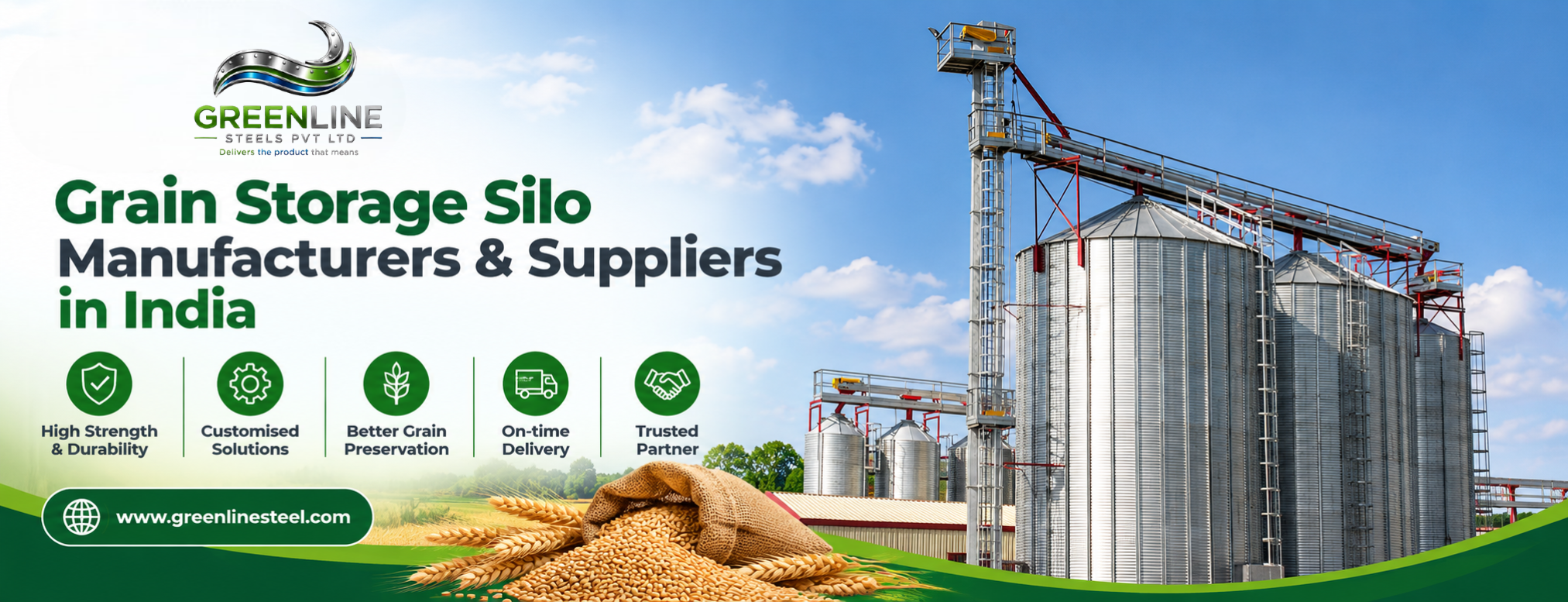
This is particularly important when comparing proposals from different Grain Storage Silo Manufacturers & Suppliers in india. A technically suitable proposal should demonstrate how the silo will be adapted to the actual project environment.
9. Consider Installation and Transportation Requirements
The cost and practicality of installation can be influenced by the way the silo is manufactured and supplied.
Modular bolted steel silo systems can provide logistical advantages because components can be transported separately and assembled at the project site. This can be particularly useful where access restrictions or project schedules make transportation of large fabricated structures difficult.
Before placing an order, buyers should clarify:
- Transportation responsibility
- Component packaging
- Site unloading requirements
- Erection methodology
- Required lifting equipment
- Installation duration
- Foundation readiness
- Testing and commissioning
- Post-installation support
These factors should form part of the total project evaluation rather than being considered after the purchase order.
10. Assess Long-Term Maintenance Requirements
The procurement process should consider the silo’s complete operating life, not only installation.
Routine inspection should cover structural components, bolts, roof sections, corrosion protection, access equipment, discharge mechanisms and moisture-related issues.
A practical maintenance strategy should also allow safe access to relevant components.
Before selecting a supplier, ask:
- Are replacement components available?
- What inspection procedures are recommended?
- How are corrosion-related issues addressed?
- What maintenance access is provided?
- Is technical support available after installation?
- Can the system be expanded later?
These questions can help distinguish between a low initial quotation and a genuinely suitable long-term storage solution.
Key Procurement Parameters at a Glance
| Parameter | Procurement question |
| Capacity | Does the proposed capacity match current and future requirements? |
| Material | Is the steel specification suitable for the application? |
| Protection | Is the corrosion-protection system appropriate for the site? |
| Structure | Has the design accounted for relevant operational and environmental loads? |
| Foundation | Are foundation requirements clearly specified? |
| Grain flow | Is the discharge configuration suitable for the stored commodity? |
| Moisture | How will the system address water ingress and grain-condition monitoring? |
| Installation | Who is responsible for erection and commissioning? |
| Maintenance | Are inspection and replacement requirements clearly defined? |
| Expansion | Can additional capacity be integrated later? |
How to Evaluate a Grain Storage Silo Manufacturer in India
Choosing among the Best Grain Storage Silo Manufactures In India should not be based on marketing claims alone. Buyers should examine manufacturing capabilities, engineering knowledge, material specifications, project experience, installation support and the supplier’s ability to customise the silo to the intended application.
A technically competent supplier should be able to discuss capacity, grain characteristics, structural requirements, foundation interfaces, corrosion protection, loading and discharge systems and site conditions.
It is also worth checking whether the supplier can provide a complete project solution rather than only supplying the steel structure. For large agro-industrial facilities, coordination between the silo, material-handling equipment, civil works and operating requirements can have a significant effect on project performance.
This is where an experienced Industrial silos manufacturer in india can provide value beyond fabrication by helping align the storage structure with the wider material-handling operation.
Greenline Steels Pvt Ltd: Engineered Storage for Agro-Industrial Applications
At Greenline Steels Pvt Ltd, we provide modular steel storage solutions designed around the operational requirements of agricultural and industrial projects. Our grain storage silos use high-quality steel construction and are designed for bulk grain storage, with capacity customised according to project requirements. We focus on structural durability, moisture protection, efficient discharge and practical installation. Our experience across storage applications allows us to work with clients on requirements ranging from agricultural storage to food processing and commercial grain-handling facilities. We also provide Pan-India service support and focus on developing storage systems that are practical to install, maintain and operate over the long term.
Conclusion
For Indian agro-industries, grain silo procurement should be approached as an engineering and operational decision rather than a simple equipment purchase. Storage capacity, grain characteristics, structural loads, steel quality, corrosion protection, foundation design, moisture management, material handling and maintenance all influence the suitability of the final system.
India’s growing foodgrain production makes dependable bulk storage increasingly important. With 357.73 million tonnes of foodgrain production recorded for 2024-25 and large quantities requiring organised storage and movement, investment in properly designed storage infrastructure has a direct role in strengthening agricultural supply chains.
The right supplier should therefore be evaluated on engineering capability, manufacturing quality, customisation, installation support and long-term service rather than price alone. A properly specified grain silo can provide the capacity, protection and operational efficiency required by modern farms, mills, food processors, warehouses and agro-industrial facilities.