


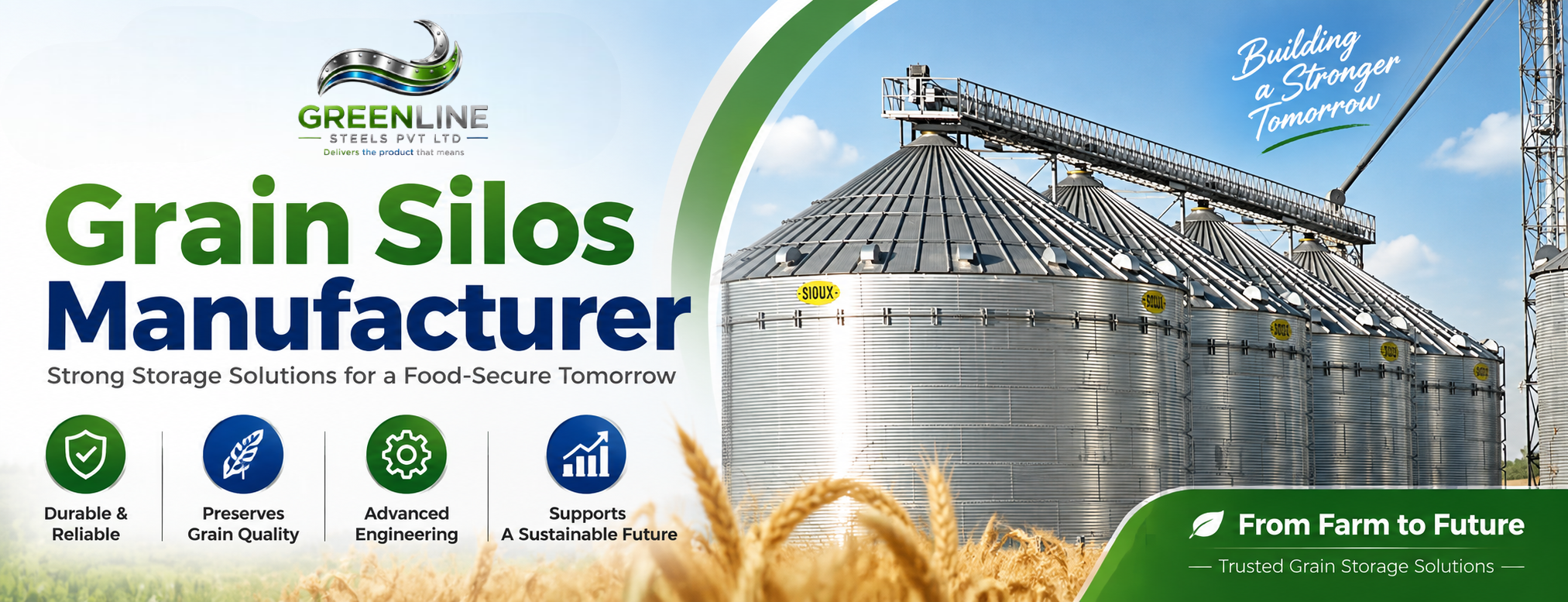
Choosing between a flat-bottom and hopper-bottom grain silo is not simply a matter of selecting one shape over another. The bottom configuration affects how grain is discharged, how much storage capacity can be utilised, how the silo integrates with conveying equipment, how frequently the stored material needs to be handled, and what the overall project requires in terms of civil and mechanical infrastructure. A grain silos manufacturer should therefore evaluate the intended storage and handling process before recommending a silo configuration.
For a rice mill, flour mill, grain warehouse, food-processing unit or agricultural storage facility, the correct configuration depends on the operating cycle rather than silo capacity alone. A silo intended for long-term bulk storage may require a different arrangement from one used for frequent batch transfer.
The decision should therefore be made after considering grain characteristics, storage duration, discharge requirements, aeration, handling capacity, site conditions and future expansion.
What Is a Flat-Bottom Grain Silo?
A flat-bottom grain silo has a cylindrical storage body supported on a flat or substantially flat base. The grain rests over the base area, while discharge is generally managed through a central or multiple outlet arrangement supported by mechanical unloading equipment.
This configuration is commonly considered for large-volume storage where grain may remain in the silo for an extended period. Because the entire floor area contributes to storage, a flat-bottom design can provide substantial usable capacity for bulk grain inventories.
However, complete emptying requires careful consideration of the discharge system. Grain remaining around the floor or outside the primary discharge zone may require sweeping or mechanical assistance, depending on the silo design and unloading arrangement.
For facilities where grain is received in large quantities and stored as inventory before planned processing or dispatch, this configuration can be practical.
What Is a Hopper-Bottom Grain Silo?
A hopper-bottom silo has a conical or sloped bottom that directs stored grain towards a lower discharge point. Gravity plays a greater role in moving the grain towards the outlet.
This arrangement can simplify discharge and reduce the amount of grain left on the silo floor after unloading. It is particularly useful where frequent filling and emptying are part of the operating cycle.
The hopper structure, however, adds engineering considerations. The bottom section must be designed to carry the loads generated by the stored grain and transfer those loads safely to the supporting structure. The foundation and support arrangement therefore require appropriate structural planning.
Hopper-bottom silos can be attractive for operations where controlled discharge, batch handling and faster turnover are important.
Flat-Bottom vs Hopper-Bottom: The Key Differences
The most important distinction is not the visible shape of the silo. It is how the configuration interacts with the complete grain handling process.
| Factor | Flat-Bottom Silo | Hopper-Bottom Silo |
| Primary strength | High-volume storage | Controlled and convenient discharge |
| Typical use | Longer-term bulk storage | Frequent filling and emptying |
| Floor utilisation | High | Reduced by hopper geometry |
| Grain discharge | Requires suitable unloading system | Gravity-assisted |
| Residual grain | May require additional floor cleaning | Generally easier to clear |
| Structural arrangement | Floor and wall loads transferred through the base | Additional hopper and support loads |
| Civil requirements | Substantial foundation and floor preparation | Foundation and support structure need careful coordination |
| Handling integration | Suitable for large storage systems | Suitable for operations requiring efficient discharge |
| Storage economics | Strong for high-volume storage | May have higher structural complexity |
| Best fit | Inventory storage | High-turnover or batch operations |
This comparison should not be treated as a universal rule. A properly engineered silo system can be configured for different operational requirements. The final choice depends on the complete storage and handling design.
1. Consider How Long Grain Will Remain in Storage
Storage duration is one of the first questions a project team should answer.
If grain is stored for weeks or months as part of inventory management, the silo needs to support stable storage conditions, aeration and monitoring. A flat-bottom configuration can be suitable for such applications where high storage volume is a priority.
If grain is frequently loaded, discharged, transferred or segregated into batches, easier discharge may become more important. A hopper-bottom arrangement can provide operational advantages because the sloping base directs material towards the outlet.
The important point is that storage duration should be evaluated alongside grain condition, moisture, aeration requirements and inventory turnover.
2. Evaluate Grain Flow and Discharge Behaviour
Grain does not behave like a liquid simply because it is stored in a container. Bulk solids interact with the silo wall, floor and outlet, and their flow behaviour depends on factors such as particle size, moisture, bulk density, friction and material characteristics.
The discharge system must therefore be designed around the stored commodity.
For a flat-bottom silo, the outlet and unloading mechanism must be capable of drawing grain from the storage mass without creating unacceptable flow problems. Where complete emptying is required, mechanical floor sweepers or other unloading arrangements may be incorporated.
A hopper-bottom silo uses the sloping base to guide grain towards the discharge point. This can simplify material movement, particularly where regular unloading is required.
The selection should therefore consider not only the silo body but also the outlet size, discharge equipment and conveying system downstream.
3. Compare Storage Capacity with Usable Capacity
A silo’s nominal volume does not automatically represent the quantity of grain that can be stored and efficiently managed.
Flat-bottom silos can make effective use of a large floor area, which is one reason they are commonly considered for high-capacity storage. The absence of a large hopper structure allows more of the overall vessel volume to be used for bulk storage.
Hopper-bottom silos allocate part of the lower structure to the hopper. This can reduce the volume available for grain compared with a similarly sized flat-bottom structure, depending on the geometry.
However, storage volume should never be considered in isolation. If the facility needs frequent discharge and the unloading system is a major operational constraint, the additional convenience of a hopper may justify its configuration.
The correct comparison is therefore usable storage capacity versus operational requirement, not simply cubic metre capacity.
4. Examine Aeration and Grain Condition Management
Aeration is an important part of bulk grain storage because temperature and moisture conditions within stored grain can influence storage performance.
Flat-bottom silos can provide a large floor area through which aeration systems may be arranged. The design of perforated floors, ducts, fans and airflow paths needs to correspond with silo diameter, grain depth and commodity characteristics.
Hopper-bottom silos require aeration arrangements that work with the sloped base and discharge geometry. The airflow distribution should be considered during the engineering stage rather than treated as an equipment addition after the silo has been selected.
Temperature monitoring should also be considered where grain is stored for extended periods. Sensor locations, monitoring points and access for inspection should form part of the overall storage design.
For a grain storage project, the silo, aeration system and monitoring arrangement should be engineered as one system.
5. Consider Loading and Unloading Frequency
A storage facility with low inventory turnover has different priorities from a processing plant receiving and transferring grain every day.
For high-frequency operations, discharge time and material flow become important productivity considerations. Hopper-bottom silos may be advantageous where the stored grain needs to move regularly towards a lower outlet.
Flat-bottom silos can still support frequent handling, but the unloading system needs to be appropriately engineered. Mechanical sweep systems, central outlets and conveyors may form part of the solution.
The correct question for the project team is therefore:
How often will each silo be filled, partially emptied and completely discharged?
The answer can have a greater influence on configuration than storage capacity alone.
6. Assess Civil and Structural Requirements
Silo selection also affects the civil scope of the project.
Flat-bottom silos require a properly designed foundation and floor arrangement capable of supporting the silo and the stored grain. Foundation design must account for site-specific soil conditions and the loads generated by the complete structure.
Hopper-bottom silos introduce additional structural requirements because the hopper transfers stored material loads through the supporting structure. The support arrangement, hopper geometry, anchor connections and foundation interface require coordination between the silo manufacturer, structural engineer and civil contractor.
This is why a quotation should not be evaluated only on the price of the silo shell. Foundation requirements, structural support, access systems, conveyors, elevators, electrical work and commissioning can all affect the final project scope.
7. Look at the Complete Grain Handling System
A silo does not operate independently.
A commercial grain storage facility may include:
- Truck unloading and intake systems
- Grain cleaners
- Bucket elevators
- Belt or screw conveyors
- Aeration fans and ducts
- Temperature monitoring
- Level indicators
- Dust control systems
- Discharge equipment
- Control panels and automation
- Sampling and inspection arrangements
The silo configuration should therefore fit the material flow through the facility.
For example, a processing plant may receive grain from trucks, clean it, transfer it into storage, and later discharge it into a processing line. The location and configuration of each silo must support this sequence without unnecessary conveying distances or handling points.
8. When Is a Flat-Bottom Silo Usually the Better Choice?
A flat-bottom configuration is generally worth considering when the primary objective is substantial bulk storage capacity.
It may suit operations where:
- Grain remains in storage for longer periods
- High storage volume is a major requirement
- Multiple silos are being installed as an inventory system
- The facility has suitable mechanical unloading equipment
- Aeration and temperature management are important
- Storage cost per unit of capacity is a major project consideration
- Future storage expansion is anticipated
For large grain warehouses and agricultural storage facilities, the ability to hold significant inventory can be more important than rapid discharge.
9. When Is a Hopper-Bottom Silo Usually the Better Choice?
A hopper-bottom configuration deserves consideration when discharge convenience and material turnover are major operational requirements.
It may be appropriate where:
- Grain is frequently discharged
- Batch handling is required
- Rapid transfer to downstream equipment is important
- Reduced residual grain is desirable
- The storage system needs gravity-assisted discharge
- The facility has a well-defined conveying and processing sequence
Hopper-bottom silos can also be useful when operational flexibility is more important than maximising the storage volume within a particular footprint.
10. How Should Procurement Teams Compare Silo Quotations?
When evaluating proposals from a grain silos manufacturer, procurement teams should avoid comparing quotations purely on silo capacity and price.
The technical comparison should include:
- Storage capacity and dimensions
Verify nominal and usable capacity and understand the basis on which capacity has been calculated. - Steel specifications
Review material specifications, thicknesses, structural components and corrosion protection. - Silo configuration
Confirm whether the proposal is flat-bottom or hopper-bottom and understand the unloading arrangement. - Aeration system
Check whether fans, ducts, perforated floors and related components are included. - Handling equipment
Establish whether elevators, conveyors, discharge equipment and associated controls are part of the scope. - Monitoring and instrumentation
Identify temperature, level and other monitoring provisions. - Foundation and civil scope
Clearly establish what is included in the manufacturer’s scope and what remains with the project owner or civil contractor. - Installation and commissioning
Check erection requirements, site responsibilities, testing and commissioning arrangements. - Future expansion
Consider whether additional silos or handling capacity can be integrated later.
This approach gives the buyer a much clearer picture of the actual project value.

Flat-Bottom vs Hopper-Bottom: The Final Decision
There is no universally superior silo configuration. The right choice depends on the operating model.
A flat-bottom silo is generally more suited to high-volume storage where inventory capacity, long-term storage and integrated aeration are key priorities. A hopper-bottom silo becomes more attractive when frequent discharge, batch movement and convenient material flow are central to the operation.
The decision should be based on the complete system, including grain characteristics, storage duration, turnover rate, discharge requirements, aeration, foundation conditions, conveying equipment and future expansion.
For this reason, organisations should involve a technically capable grain storage silos manufacturer in India at the planning stage rather than selecting a silo only from its advertised capacity.
Why Choose Greenline Steels Pvt Ltd for Grain Storage Projects?
At Greenline Steels Pvt Ltd, we provide storage solutions designed around the operational requirements of agricultural and industrial projects. Our product range includes grain storage silos alongside Zincalume storage tanks, pillow or onion tanks, artificial ponds, mild steel fabrication tanks and SMC/GRP tanks. We focus on modular storage systems, practical installation and long-term performance, with our grain silo solutions designed for safe and efficient bulk material storage. As an industrial silos manufacturer in India, we work with project requirements involving storage capacity, site conditions, handling needs and the intended application rather than treating every silo installation as the same.
Conclusion
Flat-bottom and hopper-bottom grain silos solve different operational requirements. The better configuration is the one that fits the way grain enters, remains in, moves through and leaves the facility.
For large-volume inventory storage, a flat-bottom silo can provide an efficient storage arrangement when supported by an appropriate unloading and aeration system. For operations with frequent discharge and high material turnover, a hopper-bottom silo can offer greater discharge convenience.
Before appointing the best grain storage silo manufactures in India, buyers should evaluate the complete technical scope, including silo geometry, structural design, steel specifications, aeration, unloading, conveying, monitoring, foundation requirements and installation.
A capable grain storage silo manufacturers & suppliers in India should be able to explain these factors clearly and align the silo configuration with the actual operating cycle of the facility. That approach leads to a storage system designed for the project’s requirements rather than a silo selected only on capacity or initial quotation value.
Frequently Asked Questions
A flat-bottom silo has a level base and is generally suited to larger-volume or longer-duration grain storage. A hopper-bottom silo has a sloped base that allows grain to move towards the discharge point, making it suitable where frequent unloading, batch transfer or easier clean-out is required.
Flat-bottom silos are generally more suitable for long-term bulk storage because they can provide high storage volume and are commonly used where grain remains in storage for extended periods. The final selection should also consider aeration, grain condition, storage duration and handling requirements.
A hopper-bottom silo can be appropriate when grain needs to be discharged frequently, transferred in batches or removed with minimal residual material. It is often considered for operations where faster product turnover and easier discharge are important.
Yes. The bottom configuration can affect the silo structure, foundation requirements, discharge equipment, conveying arrangement and installation requirements. Therefore, procurement teams should compare the complete project cost rather than evaluating the silo only on its quoted capacity or structure price.
The decision should be based on the grain type, required capacity, storage duration, loading and unloading frequency, discharge method, aeration requirements, available site area and future expansion plans. A qualified grain silos manufacturer can use these operating parameters to recommend the appropriate configuration.