
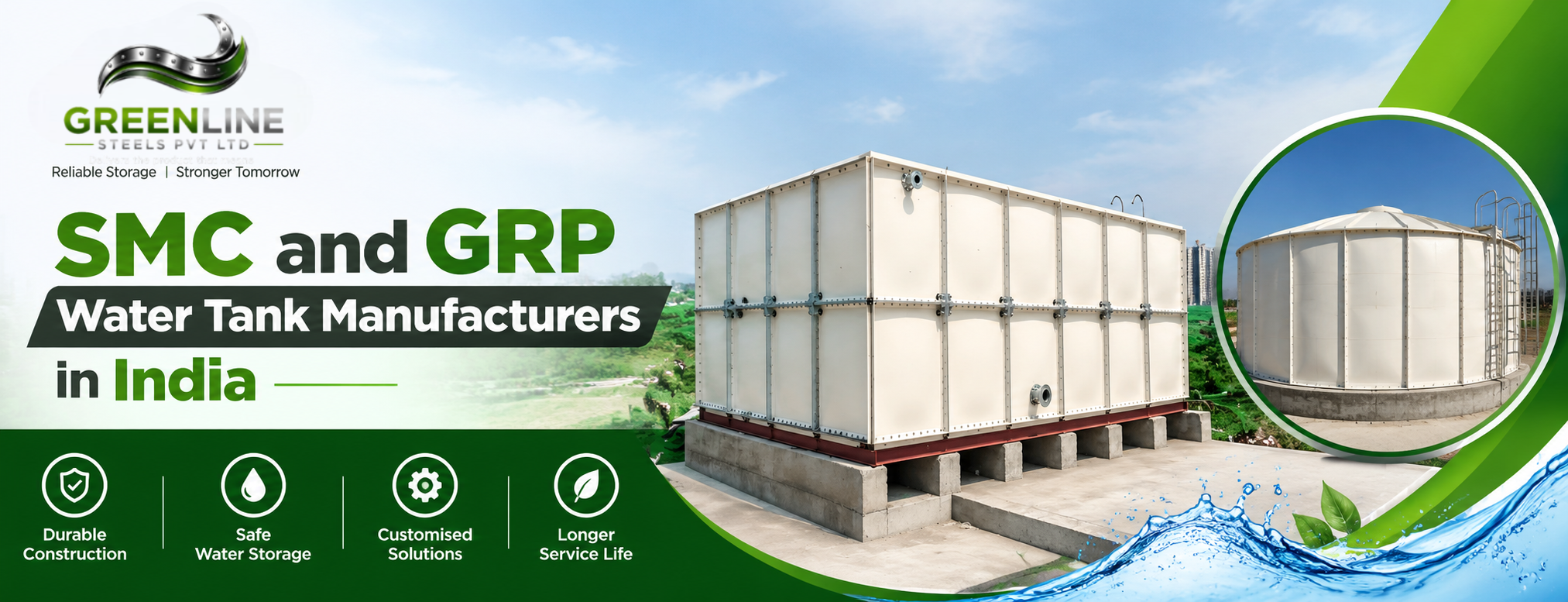
A 500 KL to 1000 KL+ water storage project requires more than increasing the number of tank panels. At these capacities, tank selection involves structural design, panel configuration, foundation conditions, water quality, site access, installation methodology, hydraulic connections and long-term maintenance.
For project consultants, EPC contractors and industrial procurement teams, the manufacturing capability of SMC and GRP water tank manufacturers in India becomes particularly important at higher capacities. A sectional tank has to function as an integrated structure after assembly. The quality of the panels, fastening system, sealing arrangement and supporting structure all contribute to the final performance of the tank.
Large-capacity SMC and GRP tanks are commonly considered for municipal water systems, industrial plants, institutional campuses, hospitals, commercial developments, fire water systems, WTP and STP projects. Each application can require a different tank configuration and specification.
Starting with Project Requirements Rather Than Tank Capacity
The first stage of a large-capacity tank project is defining the actual storage requirement. A 1000 KL requirement does not automatically mean that a single tank should be supplied as one unit.
Project teams need to assess:
- Required usable storage volume
- Operating water level
- Freeboard requirement
- Daily water consumption
- Fire water reserve
- Inlet and outlet flow requirements
- Number of connected systems
- Available installation area
- Foundation arrangement
- Access for transportation and assembly
- Future expansion requirements
- Water quality and intended use
For example, a facility may require separate potable and fire water storage rather than one common tank. An industrial facility may also need separate tanks for process water, utility water and emergency reserves.
The manufacturer therefore needs to translate the project brief into an appropriate tank arrangement before finalising the panel configuration.
Engineering the Tank for Large Storage Volumes
At 500 KL and above, hydrostatic pressure becomes an important design consideration. Water exerts increasing pressure with depth, which means the lower portions of a tank experience greater loading than the upper sections.
This affects the engineering of sectional tanks.
Panel dimensions, panel thickness, reinforcement, connection arrangements and supporting members need to be considered together. The tank cannot be assessed only by looking at the nominal material or overall capacity.
A competent SMC water tank manufacturer in India should be able to establish the appropriate configuration based on the required water depth, dimensions and site conditions.
For larger tanks, the design process may involve reviewing:
- Hydrostatic loading
- Wind loading where applicable
- Seismic considerations based on project location
- Tank aspect ratio
- Panel arrangement
- Structural support requirements
- Connection loads
- Roof loading, where applicable
- Nozzle and pipe connection locations
- Foundation tolerances
The objective is to create a tank configuration that remains structurally stable under the specified operating conditions.
Panel Configuration Becomes More Important at 1000 KL+
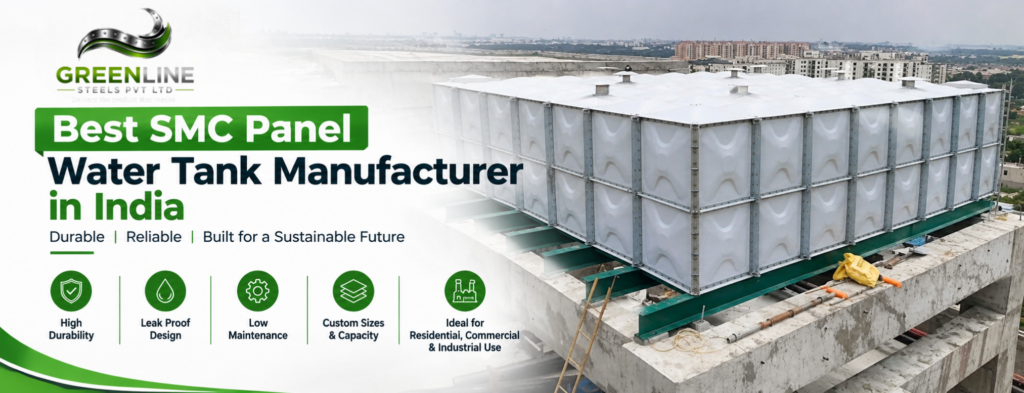
Sectional construction allows large tanks to be manufactured as individual panels and assembled at the project location. This provides an important logistical advantage over transporting a completely fabricated tank.
However, increasing capacity also increases the number of panels and connections.
Manufacturers need to determine the appropriate panel layout based on tank dimensions and design loads. The arrangement should allow the panels to work as an integrated structure after bolting and sealing.
The connection system is equally important. Bolts, washers, gaskets and sealing materials need to be selected and installed according to the manufacturer’s specified assembly procedure.
This is one reason project buyers should assess more than the quoted tank capacity when comparing SMC Panel Tanks Manufacturers in India. The technical construction method and quality control process can have a direct bearing on installation quality.
Material Selection for SMC and GRP Sectional Tanks
SMC and GRP are reinforced composite materials used for applications where corrosion resistance and controlled fabrication are important.
SMC panels are manufactured from Sheet Moulding Compound using a moulding process. GRP panels use glass reinforcement within a polymer matrix. The precise material formulation and manufacturing process can vary between manufacturers and applications.
For a 500 KL to 1000 KL+ project, buyers should review the technical specification rather than selecting a tank solely on the basis of the material name.
Important parameters may include:
- Panel construction
- Reinforcement system
- Resin characteristics
- Panel thickness
- Mechanical properties
- Surface finish
- Water-contact suitability
- UV exposure considerations
- Gasket and seal compatibility
- Fastener specifications
This is particularly relevant for potable water applications, where the materials in contact with stored water need to meet the applicable project and regulatory requirements.
A Best SMC Panel Water Tank Manufacturer in India should therefore provide clear technical documentation covering the proposed panel system and associated components.
Managing Water Tightness Across Hundreds of Connections
A large sectional tank can contain a substantial number of panel joints. Water tightness is therefore not determined by the panel material alone.
The joint design, gasket quality, bolt tightening, panel alignment and installation procedure all matter.
Before installation, the manufacturer or project team should establish:
- Correct panel identification and sequence
- Gasket positioning
- Bolt and washer placement
- Required tightening procedure
- Panel alignment tolerances
- Nozzle and connection installation
- Internal inspection
- Water filling and leak inspection
Poor alignment or incorrect gasket installation can create problems even when the individual panels meet their specified properties.
For this reason, installation supervision and quality inspection should be included in the project plan for high-capacity tanks.
Foundation and Site Preparation
The tank foundation is a critical part of the installation.
A sectional tank transfers its operational load to the supporting foundation. At 1000 KL capacity, the stored water alone represents a substantial mass. One kilolitre of water is approximately equivalent to one metric tonne of water, so a 1000 KL tank contains roughly 1000 tonnes of water when filled.
The foundation must therefore be designed and prepared according to the tank configuration and site conditions.
Important considerations include:
- Foundation levelness
- Surface condition
- Load-bearing capacity
- Settlement control
- Drainage
- Anchor arrangements where specified
- Tank footprint
- Access around the tank
- Pipework support
- Maintenance access
The tank manufacturer should provide the required foundation interface details, while the project’s structural consultant should confirm the suitability of the supporting structure for the site.
Transportation and Installation Planning
One of the main advantages of sectional SMC/GRP tanks is that individual panels can be transported to locations where moving a fully fabricated tank would be difficult.
For 500 KL to 1000 KL+ projects, logistics planning still needs to be carried out carefully.
The project team should consider:
- Delivery route
- Panel dimensions
- Site access
- Storage of panels before assembly
- Lifting equipment
- Assembly area
- Workforce requirements
- Installation sequence
- Weather conditions
- Safety requirements
The manufacturer should provide an installation methodology that corresponds with the supplied tank configuration.
A Best GRP Panel Tank Suppliers in India should be capable of supporting the project beyond dispatch by providing appropriate installation documentation and technical assistance.
Designing for Potable, Fire and Industrial Water
The intended application directly affects the tank specification.
Potable water
For drinking water storage, the focus is on suitable water-contact materials, hygienic internal surfaces, appropriate sealing components and compliance with applicable requirements.
Fire water
Fire water tanks require reliable reserve capacity and appropriate integration with the firefighting system. Suction arrangements, overflow, drainage, access and system connections need to be coordinated with the fire protection design.
Industrial water
Industrial applications can involve process water, utility water or other stored water streams. The manufacturer needs to understand the water characteristics and operating conditions before finalising the material and component specification.
An industrial grp water tank manufacturer in India should therefore assess the application instead of applying one standard tank specification to every industrial project.
Quality Control Before Dispatch
Large projects benefit from a defined inspection process before the tank components leave the manufacturing facility.
Quality checks may cover:
- Panel dimensions
- Panel surface condition
- Thickness or specified construction parameters
- Hole positioning
- Fasteners
- Gaskets
- Accessories
- Component identification
- Packaging
- Documentation
The objective is to ensure that the components arriving at the site correspond to the approved technical specification.
For large-capacity installations, missing or incorrectly supplied components can cause avoidable delays because assembly cannot always proceed until the affected items are available.
Technical Documentation for EPC and Procurement Teams
Documentation becomes particularly important when a tank forms part of a larger infrastructure project.
Depending on project requirements, buyers may request:
- Technical data sheets
- General arrangement drawings
- Panel layout drawings
- Foundation drawings
- Material specifications
- Installation manuals
- Quality inspection records
- Component specifications
- Testing procedures
- Maintenance recommendations
- Warranty documentation
- Compliance certificates where applicable
A manufacturer capable of supplying this documentation can make coordination between procurement, structural, mechanical and site teams more straightforward.
Planning for Future Capacity Expansion
One advantage of sectional construction is the potential for modular project planning.
If a facility expects water demand to increase, the initial project can be assessed with future requirements in mind. However, future expansion should not be assumed to be possible simply because a tank uses sectional panels.
The foundation, available space, hydraulic connections and structural arrangement need to be considered from the beginning.
Project consultants should therefore discuss future capacity requirements with the manufacturer before finalising the first tank configuration.
How Buyers Should Evaluate Manufacturers for 500 KL+ Projects
When selecting a supplier for a large-capacity installation, procurement teams should examine the complete project capability rather than comparing only price per kilolitre.
Key evaluation areas include:
| Evaluation area | What to assess |
| Manufacturing | Production capability and quality controls |
| Engineering | Tank design, drawings and technical support |
| Materials | Panel and component specifications |
| Capacity | Experience with large sectional tanks |
| Installation | Site assembly methodology and support |
| Quality | Inspection and testing procedures |
| Documentation | Drawings, manuals and technical records |
| Logistics | Packaging, transportation and delivery planning |
| Customisation | Ability to accommodate project-specific dimensions |
| After-sales support | Maintenance and technical assistance |
This approach is particularly relevant when evaluating SMC and GRP water tank manufacturers in India for institutional, industrial and infrastructure projects.
Why Large-Capacity Tank Projects Require a Project-Specific Approach
There is no single configuration that is appropriate for every 500 KL or 1000 KL+ installation.
Two projects with the same nominal capacity can have different tank dimensions, water levels, foundation conditions, access constraints and operating requirements.
For this reason, the manufacturer’s role should begin during technical evaluation rather than after the purchase order is issued. Early coordination can help identify foundation requirements, connection locations, installation constraints and documentation requirements before fabrication begins.
This is also where experienced SMC and GRP water tank manufacturers in India can add value through project-specific engineering and coordination.
Our Approach at Greenline Steels Pvt Ltd
At Greenline Steels Pvt Ltd, we provide modular water storage solutions for industrial, commercial, institutional, municipal and infrastructure requirements. Our SMC/GRP tanks are designed around project-specific storage capacities, including large-capacity applications. We support clients with customised manufacturing, engineering coordination, quality inspection and installation-related requirements. Our focus is to provide a practical tank solution that aligns with the project’s storage requirement, site conditions and intended application.
Conclusion
A 500 KL to 1000 KL+ SMC/GRP water tank project requires coordinated decisions across engineering, material selection, panel configuration, foundation preparation, installation, water tightness and quality control.
For project owners and procurement teams, the right manufacturer should be evaluated on its ability to manage these requirements as an integrated project. Capacity is only one part of the specification.
A technically suitable sectional tank should have a defined structural configuration, appropriate materials and components, reliable joint detailing, suitable foundation requirements and a controlled installation process. These factors become increasingly important as storage capacity increases.
Selecting the right manufacturer at the technical planning stage can help project teams establish clearer specifications, coordinate site requirements and avoid installation issues that are difficult to resolve after the tank has been delivered.
Frequently Asked Questions
Tank configuration depends on required storage volume, water depth, available footprint, panel dimensions, site conditions, foundation design, intended application and connection requirements. Large-capacity projects should be configured according to the specific engineering and operational requirements rather than capacity alone.
Yes. Sectional SMC/GRP tanks can be configured for project-specific capacities and dimensions. In larger projects, customisation may also involve panel arrangement, inlet and outlet locations, overflow, drainage, access provisions and other system connections.
EPC contractors should assess manufacturing capability, material specifications, structural design support, technical documentation, quality inspection procedures, installation methodology, large-capacity project experience and after-sales technical support.
Water tightness depends on the complete jointing system, including panel alignment, gasket quality, bolt installation and tightening, sealing arrangements and installation practices. Proper inspection during assembly and controlled filling and leak checks are also important.
Yes, sectional SMC/GRP tank systems can be considered for 1000 KL and larger storage requirements, subject to appropriate engineering, site assessment and project-specific configuration. The tank dimensions, foundation, panel arrangement, structural requirements and intended water application should be evaluated before final selection.