
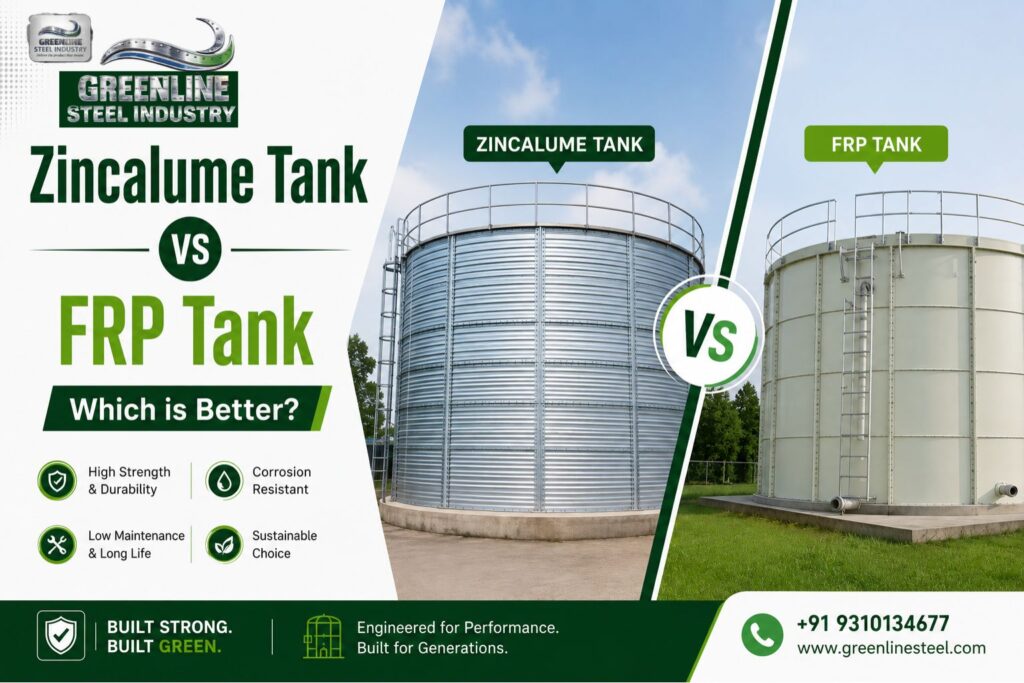
Choosing the right water storage tank is one of the most important infrastructure decisions for farms, residential properties, and commercial sites across Australia. Zincalume steel tanks and Fibre-Reinforced Polymer (FRP) tanks are two of the most widely used options — but they perform very differently across cost, durability, maintenance, and lifespan. This guide cuts through the noise so you can choose smarter.
What Are These Tanks?
Made from high-tensile steel coated with a zinc-aluminium alloy (Zincalume®), these tanks are engineered to resist corrosion and handle the harsh Australian climate. The coating forms a strong metallic barrier that protects the base steel from rust, UV, and chemical attack. Greenline Steel’s Zincalume tanks are manufactured with precision roll-forming and food-grade liners to ensure water purity.
Fibre-Reinforced Polymer tanks are made by layering fibreglass strands within a polyester or epoxy resin matrix. They are non-metallic, lightweight (relative to concrete), and are often used for chemical storage, septic applications, and water storage where corrosion of metal is a concern. However, they come with their own set of trade-offs.
Head-to-Head Comparison
Let’s compare Zincalume tanks vs FRP tanks across every factor that matters on a working property or building site.
1. Strength & Structural Integrity
Zincalume steel has a yield strength far exceeding FRP in most practical tank applications. The corrugated steel panels used in Greenline Steel tanks create exceptional hoop strength and resist external impacts — from falling branches to equipment contact. FRP tanks, while corrosion-resistant, can crack or shatter under impact, especially in cold conditions when the resin becomes brittle.
2. Corrosion & Weather Resistance
This is the most common concern raised about steel tanks — and it’s worth addressing head-on. Zincalume-coated steel tanks from Greenline Steel use a patented zinc-aluminium-silicon alloy that provides up to 4× the corrosion resistance of standard galvanised steel. Combined with a food-safe polymer liner, the steel never contacts the stored water, completely eliminating internal corrosion risk.
FRP doesn’t corrode in the traditional metallic sense, but it does degrade. UV exposure causes surface chalking and gel-coat breakdown. Resin hydrolysis — where water slowly migrates into the fibreglass matrix — weakens the tank wall structurally over time, particularly in regions with significant seasonal water temperature swings.
3. Cost – Upfront & Lifetime
Zincalume tanks generally offer a lower upfront purchase price for equivalent capacity. More importantly, they have significantly lower lifetime costs because the liner can be replaced without replacing the tank, maintenance is minimal, and they can be expanded in capacity by adding additional panels.
FRP tanks tend to be more expensive per litre of capacity at the time of purchase. When FRP tanks fail — usually via cracking, delamination, or fitting degradation — repair is difficult and expensive. In many cases, the tank must be replaced entirely.
4. Lifespan & Warranty
Properly maintained Zincalume steel tanks routinely last 20–30+ years. Greenline Steel backs this up with industry-leading warranties on both the tank structure and liner. FRP tanks typically carry a 10–15 year warranty, and real-world lifespans are heavily dependent on UV exposure, installation quality, and operating conditions.
One of the most underrated advantages of a Zincalume tank is that the internal liner — the component most exposed to water chemistry — can be replaced independently of the tank structure. This means your steel tank can effectively have multiple “lifespans.” With an FRP tank, internal surface degradation often means full replacement.
5. Installation & Transport
Zincalume tanks are shipped flat-pack and assembled on-site. This makes transport to remote locations significantly easier and more affordable — no oversized load permits, no cranes required for smaller tanks. Greenline Steel’s tanks can be assembled by a small crew in a matter of hours. FRP tanks are manufactured as a single monolithic piece, making transport to remote or difficult-access sites a major logistical and cost challenge for larger capacities.
6. Maintenance Requirements
Zincalume tanks require periodic inspection of fittings, inlet screens, and the liner. This is straightforward and inexpensive. FRP tanks can develop micro-cracks and delaminations that are difficult to detect visually until they become serious. Repairs to FRP tanks require specialist materials (resin, fibreglass cloth) and skills that are not always locally available.
Quick Reference Comparison Table
Use this table to assess Zincalume tank vs FRP tank at a glance across every key metric:
| Feature | Zincalume Tank | FRP Tank |
|---|---|---|
| Material | High-tensile steel + Zincalume® coating | Fibreglass / polyester resin composite |
| Corrosion Resistance | Excellent (4× standard galv.) + sealed liner | Good but degrades via UV & hydrolysis |
| Impact Resistance | High – steel panels absorb and flex | Low – prone to cracking & shattering |
| Upfront Cost | Lower cost per litre of capacity | Generally higher, especially at scale |
| Lifetime Cost | Low – liner replaceable, tank expandable | Higher – full replacement on failure |
| Lifespan | 20–30+ years | 10–20 years (condition-dependent) |
| Transport | Flat-pack – easy to any location | Single-piece – difficult & costly remotely |
| Installation | On-site assembly, small crew | Requires crane for large tanks |
| Repair / Maintenance | Easy, local skills & materials | Specialist repair, often full replacement |
| UV Resistance | Excellent – Zincalume coating + paint | Moderate – gel-coat chalks & degrades |
| Expandability | Yes – add panels to increase capacity | No – fixed size, cannot be expanded |
| Food-Grade Water Safe | Yes – certified food-grade liner | Depends on resin type & cure quality |
| Bushfire Resistance | Non-combustible steel structure | Combustible – resin can melt or ignite |
| Eco / Recyclability | Fully recyclable steel | Difficult to recycle composite materials |
The Verdict – Which Is Right for You?
The answer depends on your specific use case, location, and priorities. Here’s our honest breakdown:
- Long-term, cost-effective water storage
- Installation at a remote or rural property
- Bushfire-resistant tank structure
- Potable / drinking water storage
- A tank that can be expanded in capacity
- Maximum lifespan with minimum maintenance
- Flat-pack delivery to difficult-access sites
- Chemical or industrial fluid storage
- Underground tank installation
- Specific chemical resistance requirements
- Small-capacity, temporary storage
Frequently Asked Questions
▼
▼
▼
▼
▼
▼
Conclusion
When comparing Zincalume tank vs FRP tank, the data consistently points in one direction for the vast majority of Australian water storage applications: Zincalume wins. It delivers superior strength, longer lifespan, lower lifetime cost, safer performance in fire conditions, and far greater flexibility in installation and expansion.
FRP tanks have legitimate uses — primarily in specialised chemical and underground storage contexts — but for rainwater harvesting, rural water supply, stock water, and domestic or commercial water storage, a quality Zincalume steel tank from Greenline Steel is the smarter long-term investment.
Ready to size your tank, get a quote, or simply ask a question? The Greenline Steel team is ready to help.
Get a Free Quote Today
Talk to the Greenline Steel team about the right Zincalume tank size, spec, and price for your property.
#FRPTank
#WaterStorageTank
#SteelTankAustralia
#TankComparison
#GreenlineSteel
#RuralWaterStorage
#RainwaterTank