


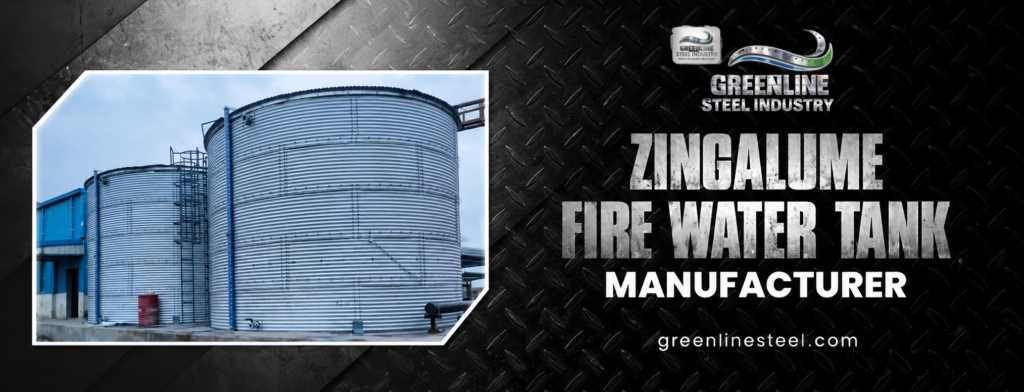
Fire water storage is a critical part of an industrial fire protection system. Hydrants, sprinklers, fire pumps and other firefighting equipment can only perform as intended when an adequate and reliable water reserve is available.
Selecting tank capacity, therefore, is not simply a matter of choosing a larger tank. The required volume depends on the fire hazards present at the facility, the firefighting systems installed, required operating duration, applicable codes and standards, water replenishment arrangements, site constraints and future expansion plans.
For industrial facilities, the selection should be supported by proper engineering calculations and coordinated with the overall fire protection design. An experienced Zincalume Fire Water Tank Manufacturer can support this process by providing information on tank configuration, storage volume, structural requirements, installation and future expansion.
This guide explains the major considerations that industrial project owners, consultants, EPC contractors and procurement teams should review before finalising fire water tank capacity.
Start With the Facility’s Fire Risk
The first step in determining fire water storage capacity is understanding what needs to be protected.
A manufacturing plant, warehouse, chemical facility, power plant and food processing unit can have very different fire hazards. The quantity and type of combustible materials, production processes, building layout and storage arrangements all influence the firefighting demand.
A fire risk assessment should consider:
- Type of industrial processes
- Nature and quantity of combustible materials
- Storage height and configuration
- Building occupancy and usage
- Fire load
- Hazard classification
- Process equipment
- Presence of flammable or combustible liquids
- Size and layout of protected areas
- Proposed firefighting systems
The purpose is to establish the design fire scenario and determine the water demand that the fire protection system must be capable of supporting.
Identify the Applicable Fire Protection Requirements
Fire water tank sizing should be based on the requirements applicable to the specific project. Depending on the facility, location and authority having jurisdiction, the design may need to consider the National Building Code of India, relevant NFPA standards, local fire authority requirements, insurance requirements and project-specific specifications.
These requirements can influence:
- Fire pump flow
- Hydrant demand
- Sprinkler demand
- Firefighting duration
- Simultaneous system operation
- Minimum effective water reserve
- Tank configuration
- Pump suction requirements
The applicable requirements should be established by the project’s qualified fire protection consultant or engineer. A tank manufacturer can then use the approved design parameters to develop an appropriate storage configuration.
This distinction is important. A tank should not be sized based on a generic capacity commonly used for another project.
Calculate the Required Fire Water Demand
Once the fire protection design parameters are established, the required storage volume can be determined.
Depending on the facility, the demand may involve multiple systems operating simultaneously. These can include:
- Hydrant systems
- Sprinkler systems
- Fire monitors
- Hose reels
- Foam-based firefighting systems
- Other dedicated suppression systems
The design team generally determines the applicable flow demand and required duration. A simplified relationship is:
Required Fire Water Volume = Design Water Flow × Required Duration
However, actual fire water calculations can involve simultaneous demands, minimum operating levels, pump arrangements and other project-specific requirements. Therefore, the formula should be treated as a basic principle rather than a complete tank-sizing methodology.
The final effective storage requirement should come from the approved fire protection design.
Understand Effective Storage Versus Nominal Tank Capacity
An important point that is sometimes missed during procurement is the difference between the tank’s nominal volume and the water actually available to the fire protection system.
A tank may have a stated geometric capacity, but not all of that volume may be usable for firefighting. Factors such as:
- Minimum suction level
- Tank outlet arrangement
- Freeboard
- Sediment allowance
- Dead storage
- Operating water levels
- Pump requirements
can affect the effective available volume.
For this reason, project teams should confirm whether the quoted tank capacity represents total geometric volume or the effective fire water storage required by the design.
This clarification can prevent capacity mismatches during project execution.
Coordinate the Tank With the Fire Pump System
The storage tank and fire pump system must be considered together.
A tank with sufficient nominal capacity may still create operational issues if its water levels, outlet arrangement or suction configuration are not compatible with the pump system.
The design should therefore consider:
- Fire pump flow and head
- Pump suction arrangement
- Tank outlet size and location
- Minimum operating water level
- Pump start and stop arrangements
- Available suction head
- Effective storage volume
- Number and configuration of pumps
Coordination between the tank supplier, fire protection consultant and pump system designer is particularly important during detailed engineering.
Determine the Required Firefighting Duration
Flow rate alone does not determine tank capacity. The duration for which the required water demand must be sustained is equally important.
The applicable duration depends on the project’s fire risk, governing standards, fire protection strategy and other site-specific considerations.
When assessing duration, the design team may need to consider:
- Hazard classification
- Fire detection and suppression arrangements
- Emergency response provisions
- Availability of external firefighting support
- Reliability of supplementary water sources
- Site location
- Project-specific fire safety requirements
The objective is to ensure that the available fire water reserve supports the required firefighting operation for the duration established by the project design.
Assess the Reliability of the Water Replenishment System
A reliable replenishment source can support operational planning, but it should not automatically be treated as immediately available fire water.
The project team should evaluate:
- Municipal water availability
- Borewell capacity
- Raw water sources
- Treatment plant output
- Rainwater harvesting systems
- Replenishment time
- Backup water sources
- Reliability during power or utility interruptions
Where replenishment is slow or uncertain, the required dedicated fire water reserve may need to account for those limitations.
The important consideration is whether the water source can actually replenish the tank within the timeframe assumed by the fire protection design.
Consider Future Expansion Before Finalising Capacity
Industrial facilities often expand after the original project is commissioned. New production lines, warehouses, process blocks and utility buildings can increase the overall fire protection demand.
Planning for these changes at the initial design stage can prevent expensive modifications later.
Review:
- Planned production expansion
- Future warehouse areas
- Additional hydrant networks
- Future sprinkler coverage
- New process buildings
- Additional fire protection zones
Modular Zincalume tanks can be particularly useful where future expansion is reasonably foreseeable. Their panel-based construction can provide greater flexibility than permanently fixed storage structures, subject to structural and engineering feasibility.
However, expansion should not be assumed to be possible for every tank configuration. The manufacturer and structural designer should confirm the permissible expansion arrangement before the initial installation.
Check Available Space and Site Access
Tank volume is only one part of the installation decision. The available site area and access conditions can significantly influence the tank configuration.
Before finalising the design, review:
- Available foundation area
- Tank diameter and height
- Fire pump room location
- Fire tender access
- Crane or lifting access
- Underground utilities
- Existing structures
- Drainage arrangements
- Maintenance access
- Required clearances
Where land is limited, a taller tank configuration may provide the required volume within a smaller footprint, subject to structural design and site conditions.
Installation access should also be considered from the beginning. A tank that can be transported and assembled efficiently can simplify project execution, particularly where access for large prefabricated structures is restricted.
Evaluate the Site Environment
Material selection becomes increasingly important when tanks are installed in demanding environments.
Industrial sites may be exposed to:
- High humidity
- Coastal conditions
- Chemical vapours
- Dust
- Temperature variations
- Industrial pollutants
- Aggressive atmospheric conditions
Zincalume steel uses an aluminium-zinc alloy coating designed to provide corrosion protection to the underlying steel. The suitability of the coating system should still be evaluated against the actual site environment and project specifications.
For demanding applications, the manufacturer should be able to provide relevant material and coating specifications so that the engineering team can assess suitability.
Why Zincalume Is Considered for Industrial Water Storage
Zincalume steel is used in modular tank construction because its aluminium-zinc alloy coating provides corrosion protection while supporting the durability requirements of steel storage structures.
For industrial applications, other practical characteristics can also be important:
- Bolted modular construction
- Factory-manufactured panels
- Transportability
- On-site assembly
- Configurable dimensions
- Potential for capacity expansion
- Reduced dependence on extensive on-site fabrication
The actual performance of a tank depends on the material specification, coating system, liner, structural design, installation quality and operating environment. These factors should be assessed together rather than treating the material name alone as a guarantee of service life.
Compare Lifecycle Cost, Not Just Purchase Price
A fire water tank is a long-term infrastructure asset. Procurement decisions based solely on the initial quotation may overlook important costs associated with installation, maintenance and future modifications.
A proper lifecycle assessment can include:
- Tank supply cost
- Foundation requirements
- Transportation
- Installation
- Coating and liner requirements
- Inspection
- Maintenance
- Repairs
- Future capacity expansion
- Replacement considerations
Modular construction may also offer logistical benefits because individual panels can be transported and assembled at the project site rather than transporting a complete tank.
The right choice is the system that satisfies the technical requirements while providing an appropriate balance between initial investment, installation requirements and long-term maintenance.
Key Technical Information to Request From the Manufacturer
Before finalising a fire water tank, procurement teams should request sufficient technical documentation to evaluate the proposed system.
Important information may include:
- Tank capacity and dimensions
- Effective storage volume
- Steel grade and thickness
- Zincalume coating specification
- Liner specification
- Structural calculations
- Design loads
- Wind and seismic design criteria
- Foundation requirements
- Tank inlet and outlet details
- Overflow and drain arrangements
- Installation methodology
- Inspection and maintenance requirements
- Warranty terms
- Relevant project references
The documentation should be reviewed by the project’s qualified engineering team to confirm that the proposed tank meets the approved design requirements.
Questions to Ask Before Selecting a Zincalume Fire Water Tank
Before placing an order, project owners and consultants should clarify the following:
- What effective fire water volume is required by the approved design?
- What nominal tank capacity will provide that effective volume?
- Which fire protection standards and project specifications have been considered?
- Is the tank compatible with the proposed fire pump and suction arrangement?
- What steel and coating specifications are being offered?
- What liner material and specification will be used?
- What foundation and civil works are required?
- Has the site environment been considered in the material selection?
- Can the tank be expanded if the facility’s water demand increases?
- What structural design criteria have been used for wind and seismic loads?
- What installation support does the manufacturer provide?
- What inspection, maintenance and after-sales support are available?
Getting these details in writing makes technical comparison between suppliers much easier and reduces the possibility of scope gaps during installation.
Choosing the Right Zincalume Fire Water Tank Manufacturer
The manufacturer plays an important role in translating the project’s approved storage requirement into a practical tank configuration.
When evaluating a Zincalume Fire Water Tank Manufacturer, consider more than manufacturing capacity. Look at:
- Relevant industrial project experience
- Material and coating specifications
- Engineering capabilities
- Manufacturing quality controls
- Structural design support
- Installation expertise
- Customisation capabilities
- Documentation and testing
- Warranty provisions
- After-sales support
- Ability to execute projects across different locations
A manufacturer with experience across industrial and infrastructure applications can also help identify practical installation and configuration considerations before fabrication begins.
Greenline Steel Industry for Industrial Water Storage Solutions
At Greenline Steel Pvt Ltd, we provide modular storage solutions for industrial, agricultural, municipal and infrastructure applications.
Our product range includes Zincalume storage tanks, grain storage silos, pillow or onion tanks, artificial water ponds, mild steel fabrication tanks and SMC/GRP tanks.
For industrial projects requiring fire water storage, our team can work with project stakeholders to understand the required capacity, site conditions, configuration and installation requirements. Our modular tank approach is designed to support efficient transportation and on-site assembly while allowing project-specific configurations.
We also support customers through the project process, from initial discussions and product selection to installation coordination and after-sales assistance.
For applications where portability or temporary storage is more important than permanent infrastructure, a Flexible Water Storage Tank Manufacturer can provide an alternative solution. Flexible tanks can be considered for temporary storage, emergency water supply and other applications where rapid deployment is required. The appropriate system should always be selected according to the project’s technical and operational requirements.
Final Thoughts
Selecting fire water tank capacity for an industrial facility requires more than choosing a standard tank size. The decision should begin with the facility’s fire risk and approved fire protection design, followed by a detailed assessment of water demand, firefighting duration, effective storage, pump requirements, site constraints and future expansion.
Material selection is another important consideration. Zincalume modular construction can offer practical benefits for industrial storage, particularly where corrosion resistance, transportability, modular installation and potential future expansion are important project considerations.
Most importantly, the tank should be treated as part of the complete fire protection system rather than as an isolated storage product. Coordination between the fire protection consultant, civil and structural engineers, pump supplier, EPC contractor and tank manufacturer helps ensure that the final installation meets the project’s functional requirements.
By working with an experienced Zincalume Fire Water Tank Manufacturer and basing capacity selection on project-specific engineering requirements, industrial organisations can make a more informed investment in reliable fire water infrastructure.