A pond liner is the part of an artificial pond that most people never see once the project is complete. Yet it has one of the biggest effects on water retention, maintenance costs and the long-term reliability of the entire system.
Choose the right liner and the pond can store water efficiently through changing seasons. Choose the wrong one, and the project may face seepage, damaged seams, liner movement or repeated repairs.
For farmers, aquaculture operators, industrial facilities and infrastructure contractors, the common comparison is HDPE versus PVC. Both materials can create an effective barrier, but they behave differently once placed on the ground.
Reputable artificial pond manufacturers in India do not recommend a liner simply because one material is more popular. The decision should account for pond shape, soil condition, stored liquid, sunlight exposure, expected service conditions and installation quality.
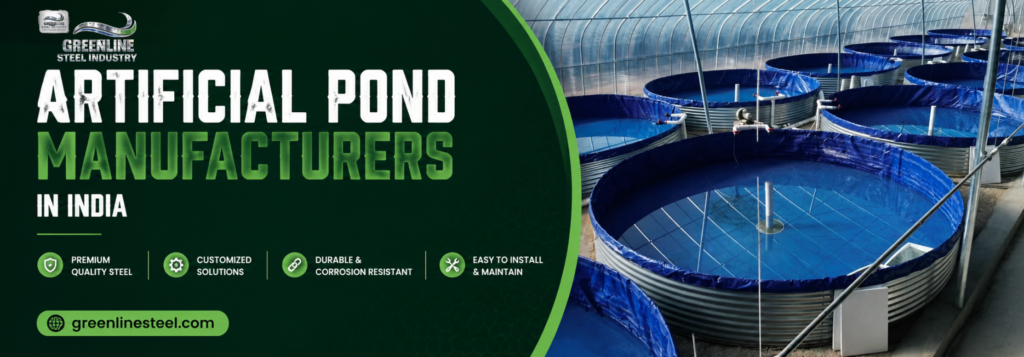
Greenline Steel Industry provides artificial pond systems using PVC and HDPE geomembranes for agriculture, irrigation, aquaculture and industrial water storage. The company’s pond systems are designed around leak prevention, UV resistance, chemical resistance and on-site welding and sealing.
So, which liner is better? The answer depends on where and how the pond will be used.
Understanding HDPE Pond Liners
HDPE stands for high-density polyethylene. It is a tough geomembrane commonly used in water reservoirs, agricultural ponds, industrial containment systems, aquaculture facilities and larger artificial ponds.
One of HDPE’s strongest qualities is chemical resistance. It performs well against many acids, alkalis and contaminants, making it a practical choice where the stored water may contain fertilisers, treatment chemicals or industrial residues. Technical guidance from geomembrane specialists also identifies HDPE as having stronger chemical resistance than PVC against many acids, bases and hydrocarbons.
HDPE is also widely selected for exposed applications. Properly formulated sheets often contain carbon black and stabilising additives that help the material withstand ultraviolet exposure and environmental ageing.
This is particularly relevant in India, where agricultural and industrial ponds may remain exposed to strong sunlight for long periods.
The trade-off is stiffness. HDPE does not drape as easily over sharp curves, corners and irregular pond contours. It needs a properly prepared subgrade, careful positioning and skilled thermal welding.
This means the quality of the installation is just as important as the quality of the sheet. Even a strong liner may underperform when placed over stones, poorly compacted soil or uneven slopes.
When comparing HDPE Pond Liner Manufacturers in India, buyers should therefore look beyond sheet thickness and price. Material quality, seam welding, subgrade preparation and quality checks all matter.
Understanding PVC Pond Liners
PVC stands for polyvinyl chloride. PVC geomembranes are known for flexibility and their ability to conform to irregular surfaces.
This makes PVC useful for smaller ponds, decorative water features, complex layouts and projects containing curved edges or detailed shapes. The material can settle more closely against the prepared ground, reducing some of the placement challenges associated with a stiffer liner.
PVC can also be fabricated into larger panels before being brought to the project site. Fewer field seams may simplify installation in certain situations, although the actual method depends on the liner specification and project design.
The main limitation is that PVC performance depends heavily on its formulation. Plasticisers are added to make the material flexible, and the liner’s response to chemicals, sunlight and long-term exposure can vary according to its composition.
PVC may not offer the same broad chemical resistance as HDPE, particularly where oils, fuels, aggressive chemicals or industrial contaminants are involved. Chemical compatibility should always be checked for the exact liquid being stored rather than assumed from the material name alone.
For clean water storage, controlled aquaculture systems or irregular pond shapes, PVC may still be a practical option when the liner is properly specified and installed.
HDPE vs PVC Pond Liners: Comparison Table
| Comparison factor | HDPE pond liner | PVC pond liner |
| Flexibility | Stiffer and less adaptable to tight curves | Highly flexible and suitable for irregular shapes |
| UV exposure | Strong performance when properly UV stabilised | Performance depends more heavily on formulation and protection |
| Chemical resistance | Broad resistance to many chemicals and contaminants | Suitable for many water applications but less resistant to certain chemicals and hydrocarbons |
| Installation | Requires careful placement and skilled thermal welding | Easier to position around complex contours |
| Large pond suitability | Well suited to large agricultural and industrial ponds | Better suited to smaller or geometrically complex ponds |
| Puncture protection | Strong material, but still requires a smooth subgrade | Flexible, but also needs protection from sharp stones and rough ground |
| Seam quality | Heat-welded seams require trained installers and testing | Seaming method depends on the PVC specification and panel design |
| Typical applications | Farm ponds, irrigation reservoirs, industrial storage and large aquaculture ponds | Decorative ponds, smaller water bodies and irregularly shaped installations |
| Long-term exposed use | Often preferred for demanding outdoor exposure | Should be evaluated according to formulation and expected exposure |
| Overall project cost | May offer strong lifecycle value for large projects | Can simplify installation on smaller or complex sites |
The table does not mean that every HDPE product will outperform every PVC product. Sheet quality, thickness, raw materials, installation conditions and workmanship can change the final result.
Which Liner Is Better for Agricultural Ponds?
For large agricultural ponds exposed to sunlight, changing weather and regular irrigation use, HDPE is often the stronger choice.
Farm ponds usually need to store substantial quantities of water through dry periods. A leak can reduce the water available for irrigation and increase dependence on borewells, tankers or unreliable rainfall.
HDPE’s combination of strength, UV resistance and chemical compatibility makes it suitable for many farm water storage applications. This is why searches for agriculture pond liner manufacturers in India commonly lead buyers towards HDPE-based systems.
However, liner selection should still consider the site.
A pond built on rocky land may require additional protective layers beneath the geomembrane. A project on soft or unstable soil may need better compaction and slope preparation. A liner should not be placed directly over roots, stones or sharp construction debris.
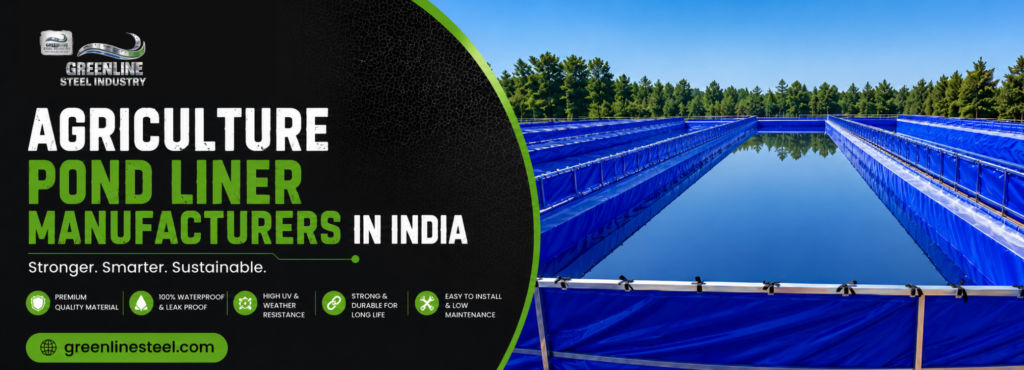
Greenline Steel Industry’s artificial pond solutions are intended for agricultural water storage and irrigation as well as aquaculture and industrial use. Its systems use on-site welding and sealing to create a continuous water-retaining barrier.
What Works Better for Fish Farming?
Both HDPE and PVC can be used for fish ponds, but the material must be selected carefully.
The liner should be suitable for continuous water contact and compatible with the conditions inside the pond. Aquaculture projects may involve aeration systems, feed residue, cleaning agents, water treatment products and regular movement around the pond.
HDPE is frequently chosen for large commercial aquaculture ponds because it is durable and suitable for exposed outdoor conditions. PVC may work well in smaller systems or pond designs where flexibility is especially valuable.
The decision should never be based on flexibility alone. Buyers should discuss the pond dimensions, species, water treatment process, operating temperature and cleaning method with the supplier before installation.
Reliable HDPE Pond Liner Manufacturers & Suppliers in India should be able to explain why a particular material, thickness and installation method suit the intended aquaculture application.
When PVC May Be the Better Option
HDPE may be the stronger default for many demanding artificial ponds, but PVC has a clear place in the market.
PVC can be considered when:
- The pond has several curves or detailed contours
- The site is difficult to line with a stiff sheet
- The application involves clean water rather than aggressive liquids
- The liner will receive suitable protection from harsh exposure
- The project is relatively small
- Faster positioning around irregular ground is important
A well-selected PVC system can perform effectively when the project conditions suit the material.
The mistake is assuming that one liner is automatically better for every pond. Experienced pond liner manufacturers in India assess the application before recommending the material.
Installation Can Matter More Than Material
Many liner failures blamed on HDPE or PVC are actually installation problems.
A pond base should be smooth, compacted and free from sharp objects. The slope must be stable. Geomembrane panels should be placed without excessive stress, and seams should be completed under suitable site conditions.
HDPE welding requires controlled temperature, pressure and travel speed. Trial seams and field quality checks help confirm that the welding equipment and technique are suitable for the conditions on site. Geosynthetic Institute guidance specifically recognises trial seams as a way to establish proper machine settings for geomembrane seaming.
Attention should also be given to anchor trenches, inlet and outlet connections, pipe penetrations and exposed edges. These areas are common weak points when the installation is rushed.
Buying a heavier sheet does not compensate for poor ground preparation. A successful artificial pond is a complete lining system, not simply a roll of geomembrane.
Questions to Ask a Pond Liner Supplier
Before approving a quotation, ask the supplier:
- Which liner is recommended for the stored liquid and why?
- How will the subgrade be prepared?
- What protection is required beneath the liner?
- How will sheets be joined and sealed?
- Will field seams be inspected or tested?
- How will pipe connections and corners be treated?
- Is the liner intended for continuous outdoor exposure?
- What project information is needed before material selection?
The answers reveal whether the supplier is offering a site-specific solution or simply quoting a sheet.
HDPE or PVC: The Final Decision
For large agricultural ponds, irrigation reservoirs, exposed fish ponds and industrial water storage, HDPE will often be the more suitable option. Its strength, chemical resistance and outdoor performance make it a dependable choice for demanding applications.
PVC can be better when the pond has complex curves, irregular contours or a smaller footprint where flexibility simplifies installation.
The best decision should be based on the entire project rather than one product feature. Soil, sunlight, liquid chemistry, pond shape and installation workmanship all influence performance.
Greenline Steel Industry offers PVC and HDPE geomembrane-based artificial pond systems for water storage across farming, aquaculture, industrial and infrastructure applications. By consulting experienced artificial pond manufacturers in India, project owners can select a liner that fits the site instead of paying later for leakage and avoidable repairs.
A liner is not merely a sheet placed under water. It is the barrier protecting the water, the surrounding soil and the investment made in the pond.